Verified Solution • 2025–26 Session
moderate
QJEEAdv18Chef8d: JEE Advanced 2018 Chemistry - Class 11 JEEAdv18Chef8d Solution: For a reaction, the plots of and with time at temperature and…
For a reaction, the plots of and with time at temperature and are given below.

If {T_2} > {T_1}, the correct statement(s) is (are) (Assume and are independent of temperature and ratio of at to at is greater than Here and are enthalpy, entropy, Gibbs energy and equilibrium constant, respectively.)
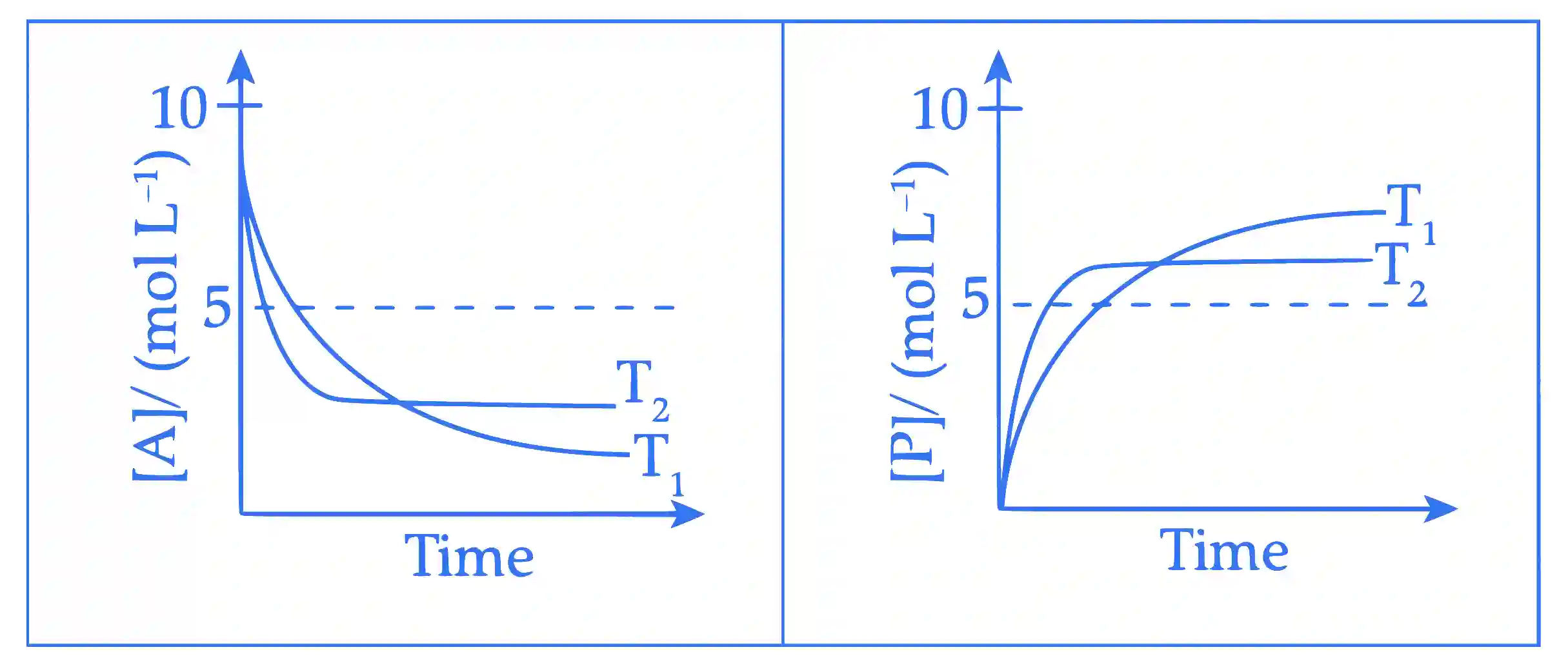
If {T_2} > {T_1}, the correct statement(s) is (are) (Assume and are independent of temperature and ratio of at to at is greater than Here and are enthalpy, entropy, Gibbs energy and equilibrium constant, respectively.)
Multiple Choice Options
- A
- B
- C
- D
Step-by-Step Verified Solution
For the reaction at equilibrium
At any temperature:
Concentration of at equilibrium [A]_{e q}<5 Concentration of at equilibrium [\mathrm{P}]_{e q}>5
Equilibrium constant
\mathrm{K}_{e q}>1
\text{Also,}~~ \frac{\ln \mathrm{K}_{\mathrm{T}_1}}{\ln \mathrm{K}_{\mathrm{T}_2}}>\frac{\mathrm{T}_2}{\mathrm{~T}_1}
It can be clearly seen from diagram that concentration of reactant is lesser and that of product is higher at compared to . Hence,
equilibrium constant is higher at than . The reaction is exothermic.
i.e., \Delta \mathrm{H}^{\circ}<0 for forward reaction
The expression for the spontaneity and Gibbs free energy of reaction:
Since, both and are less than zero \left\{\Delta \mathrm{H}^{\circ}<0\right. and \left.\Delta \mathrm{G}^{\circ}<0\right\}
If \Delta \mathrm{H}^{\circ}>\Delta \mathrm{G}^{\circ} , then \Delta \mathrm{S}^{\circ}>0
Otherwise,
If \Delta \mathrm{H}^{\circ}<\Delta \mathrm{G}^{\circ} , then \Delta \mathrm{S}^{\circ}<0
we know,
Its given, \ln \mathrm{K}_{\mathrm{T}_1}>\ln \mathrm{K}_{\mathrm{T}_2}
This is possible only if \Delta S^{\circ}<0
Hence,