QJEEAdv16Phc10a: JEE Advanced 2016 Physics - Class 12 JEEAdv16Phc10a Solution: An infinite line charge of uniform electric charge density l…
Multiple Choice Options
- A https://ik.imagekit.io/novatra/photos/001dd247916571f4be43c12bf39d4b63b6523e1e8e37e96dd40ad68854eb549c.webp
- B https://ik.imagekit.io/novatra/photos/3dd155aed2ca8ad2585ef347a91388e5d57e424d321a584bd9c3f899450735c4.webp
- C https://ik.imagekit.io/novatra/photos/c174844b1de2dc4d4a8e3782168e64575805db7d81dfd84a5c6b447f220aaf9e.webp
- D https://ik.imagekit.io/novatra/photos/108523e38ed584ec09b662410314c4bd38476036e1105720a9a3a0d2d45e0b47.webp
Step-by-Step Verified Solution
Let the charge per unit length on the axis be (t) at a time t. The electric field due to this line charge at a radial distance r is given by
. ...... (1)
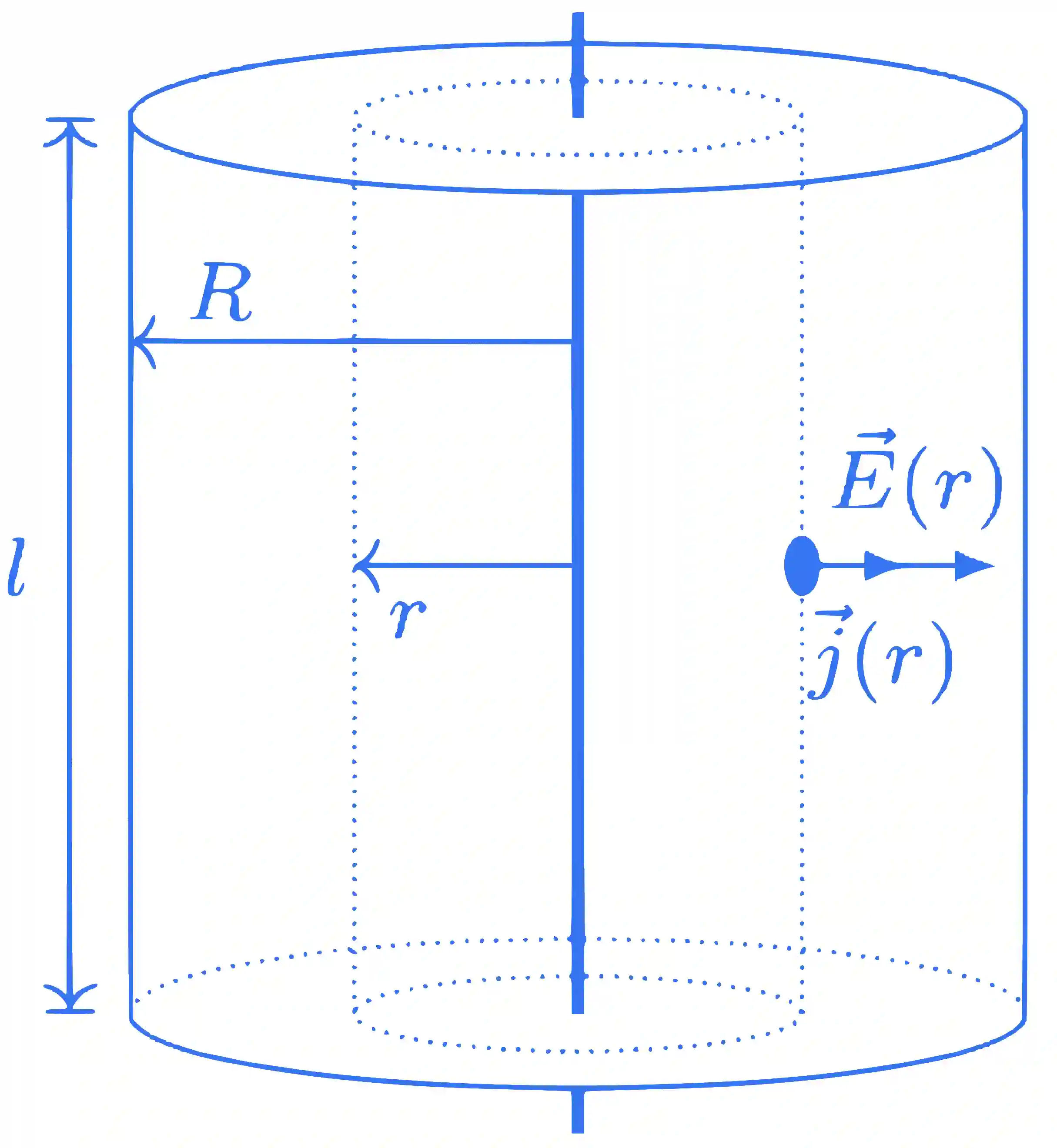
The free charges inside the conductor start moving radially due to the presence of electric field. The current density at a point is defined as the current flowing across a unit area placed perpendicular to the direction of current flow. The current density at a point is related to the electric field at that point by Ohm's law i.e.,
, ....... (2)
where is the electrical conductivity of the conductor. The current through a cylindrical shell of radius r and length l is given by
. ...... (3)
By conservation of charge, the current I is equal to the rate of decrease of charge q on axial line segment of length l i.e.,
. ...... (4)
From equations (1) - (4)
.
Integrate with initial condition (t = 0) = 0 to get
,
Substitute (t) in equation (2) to get
.
Note that current density varies as 1/r with radial distance r. It decreases exponentially with time and becomes zero at t .