Verified Solution • 2025–26 Session
moderate
QJEEAdv16Pha231: JEE Advanced 2016 Physics - Class 12 JEEAdv16Pha231 Solution: Light of wavelength ph falls on a cathode plate inside a vacuum …
Light of wavelength ph falls on a cathode plate inside a vacuum tube as shown in the figure. The work function of the cathode surface is and the anode is a wire mesh of conducting material kept at a distance d from the cathode. A potential difference V is maintained between the electrodes. If the minimum de-Broglie wavelength of the electrons passing through the anode is e, which of the following statement(s) is (are) true?

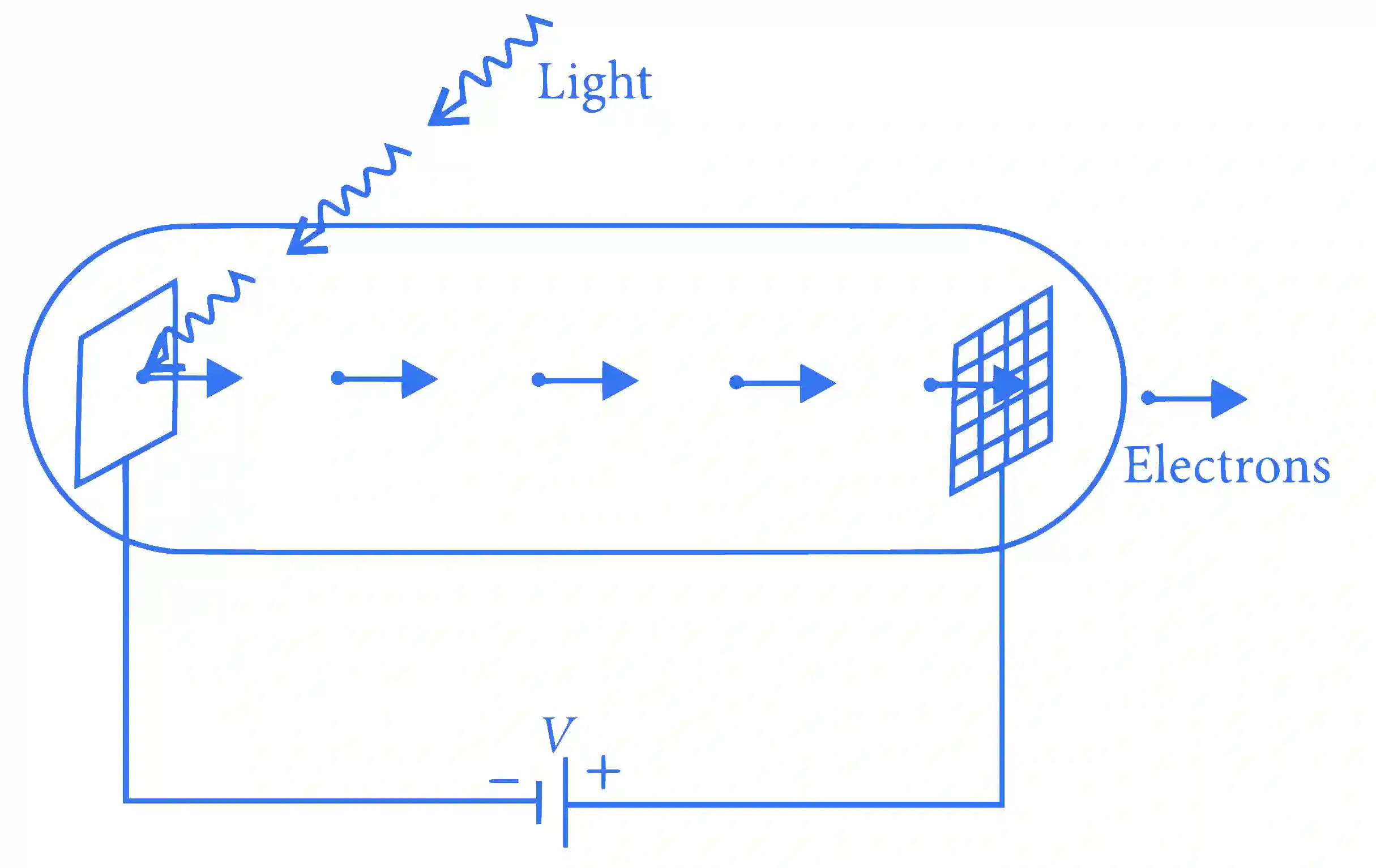
Multiple Choice Options
- A e increases at the same rate as ph for ph < hc/
- B e is approximately halved, if d is doubled
- C e decreases with increase in and ph
- D For large potential difference (V >> /e), e is approximately halved if V is made four times
Step-by-Step Verified Solution
In photo-electric effect, the maximum kinetic energy of the photo-electron ejected at the cathode, is given by
,
where ph is the wavelength of the incident light and is the work function of the material. The ejected photoelectrons are accelerated from the cathode to the anode by a potential V. Thus, the maximum kinetic energy of the photo-electron at the anode is
.
Now, minimum de-Broglie wavelength of electrons passing through anode,
...... (i)
D : For V > > \phi e
If V is made four times, e becomes , i.e. halved.
C : When and ph increases, e also increases.
A : From (i)
I : e does not depend on d.