Verified Solution • 2025–26 Session
moderate
QJEEAdv16Ph9b9d: JEE Advanced 2016 Physics - Class 11 JEEAdv16Ph9b9d Solution: Two loudspeakers M and N are located 20m apart and emit sound…
Two loudspeakers M and N are located 20m apart and emit sound at frequencies 118 Hz and 121 Hz, respectively. A car in initially at a point P, 1800 m away from the midpoint Q of the line MN and moves towards Q constantly at 60 km/h along the perpendicular bisector of MN. It crosses Q and eventually reaches a point R, 1800 m away from Q.
Let v(t) represent the beat frequency measured by a person sitting in the car at time t. Let vP, vQ and vR be the beat frequencies measured at locations P, Q and R respectively. The speed of sound in air is 330 ms 1. Which of the following statement(s) is (are) true regarding the sound heard by the person?
Let v(t) represent the beat frequency measured by a person sitting in the car at time t. Let vP, vQ and vR be the beat frequencies measured at locations P, Q and R respectively. The speed of sound in air is 330 ms 1. Which of the following statement(s) is (are) true regarding the sound heard by the person?
Multiple Choice Options
- A The rate of change in beat frequency is maximum when the car passes through Q
- B vP + vR = 2vQ
- C The plot below represents schematically the variations of beat frequency with time
- D The plot below represents schematically the variation of beat frequency with time
Step-by-Step Verified Solution
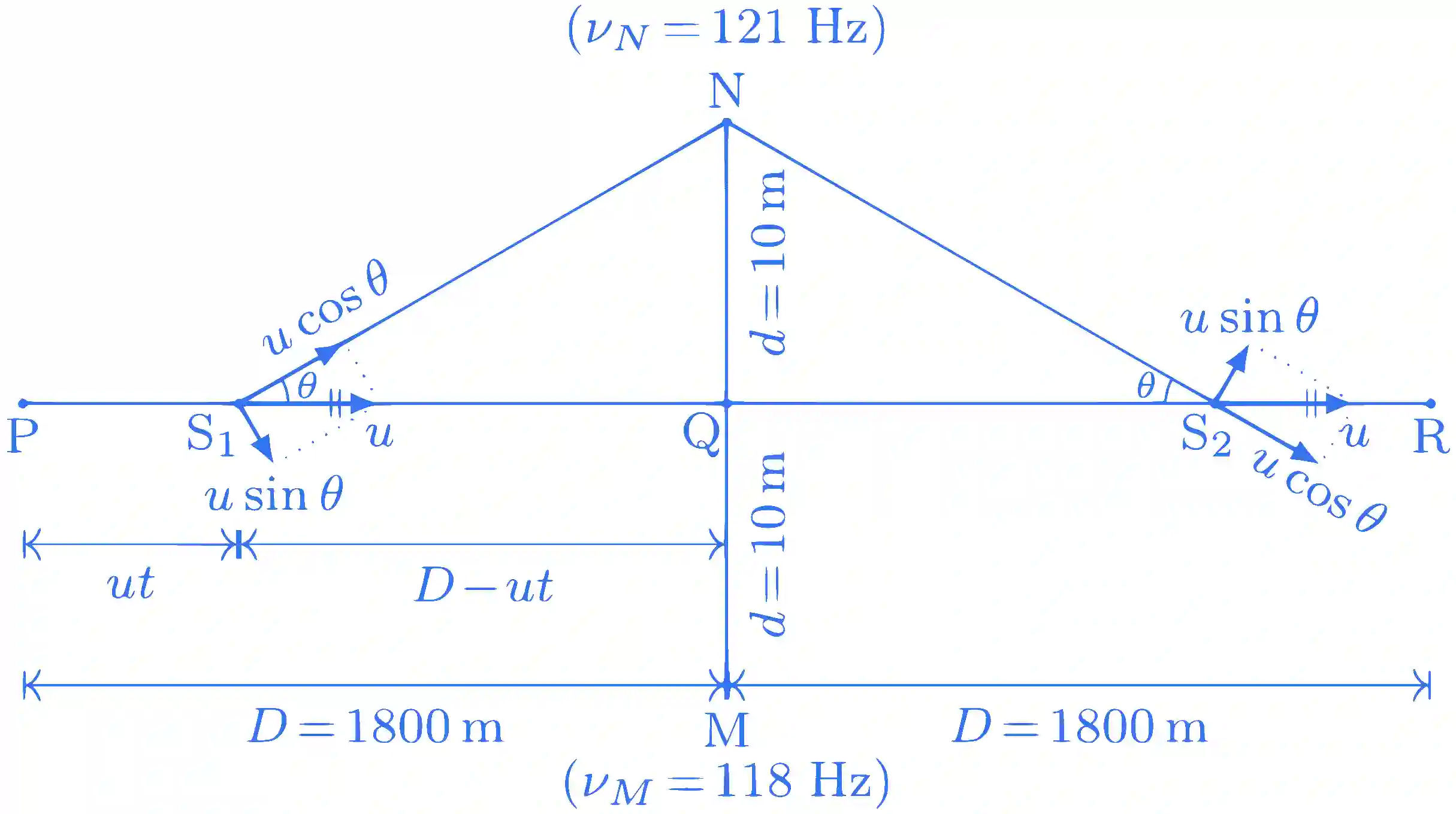
Consider the time when car is at between and . The distance travelled by the car in time is . At this instant, the lines and both make angle with the velocity vector . The component of observer (person sitting in the car) velocity towards the sources and is . The sources and are at rest i.e., . Apply Doppler's effect equation to get frequencies of the sources and heard by the observer as
The beat frequency heard by the observer at time is
Now, consider the time when car is at between and . The distance travelled by the car in time is . At this instant, the lines and both make angle with the velocity vector . The component of observer velocity towards the sources and is . Apply Doppler's effect equation to get
The beat frequency heard by the observer at time is
Substitute and in equation (1) to get and and substitute in equation (2) to get i.e.,
Differentiate equations (1) w.r.t. time t to get rate of change of beat frequency
...........(3)
From equation (3), the slope is negative and its magnitude is maximum when (denominator is minimum). Thus the rate of change of beat frequency is maximum when car passes through .