Verified Solution • 2025–26 Session moderate

QJEEAdv16Ph744b: JEE Advanced 2016 Physics - Class 12 JEEAdv16Ph744b Solution: In the circuit shown below, the key is pressed at time t = 0.…

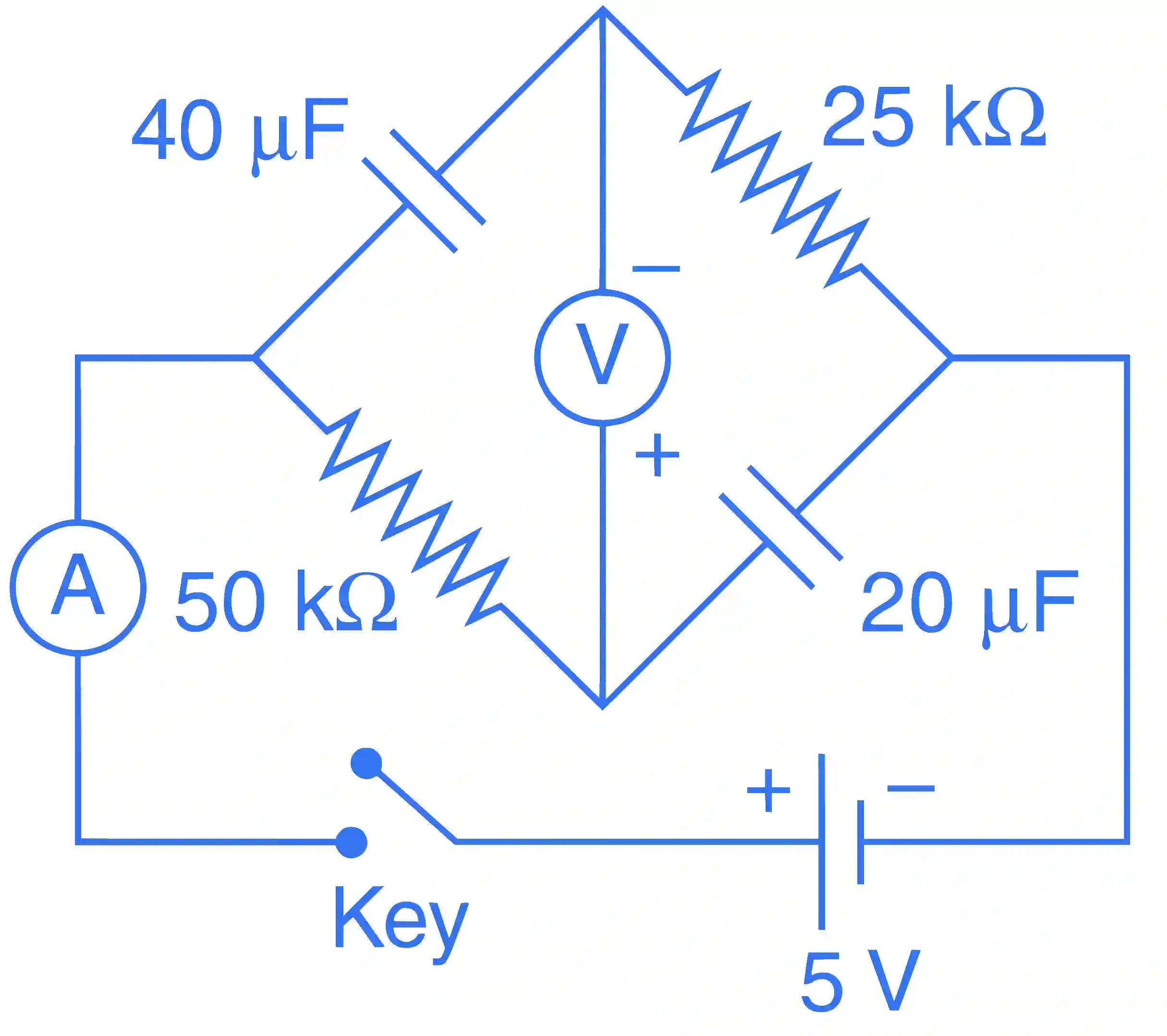
In the circuit shown below, the key is pressed at time t = 0. Which of the following statement(s) is (are) true?

JEE Advanced 2016 Paper 2 Offline Physics - Current Electricity Question 24 English

Multiple Choice Options

  • A The voltmeter display −- 5V as soon as the key is pressed and displays +5 V after a long time
  • B The voltmeter will display 0 V at time t = ln 2 seconds
  • C The current in the ammeter becomes 1/e of the initial value after 1 second
  • D The current in the ammeter becomes zero after a long time

Step-by-Step Verified Solution

JEE Advanced 2016 Paper 2 Offline Physics - Current Electricity Question 24 English Explanation

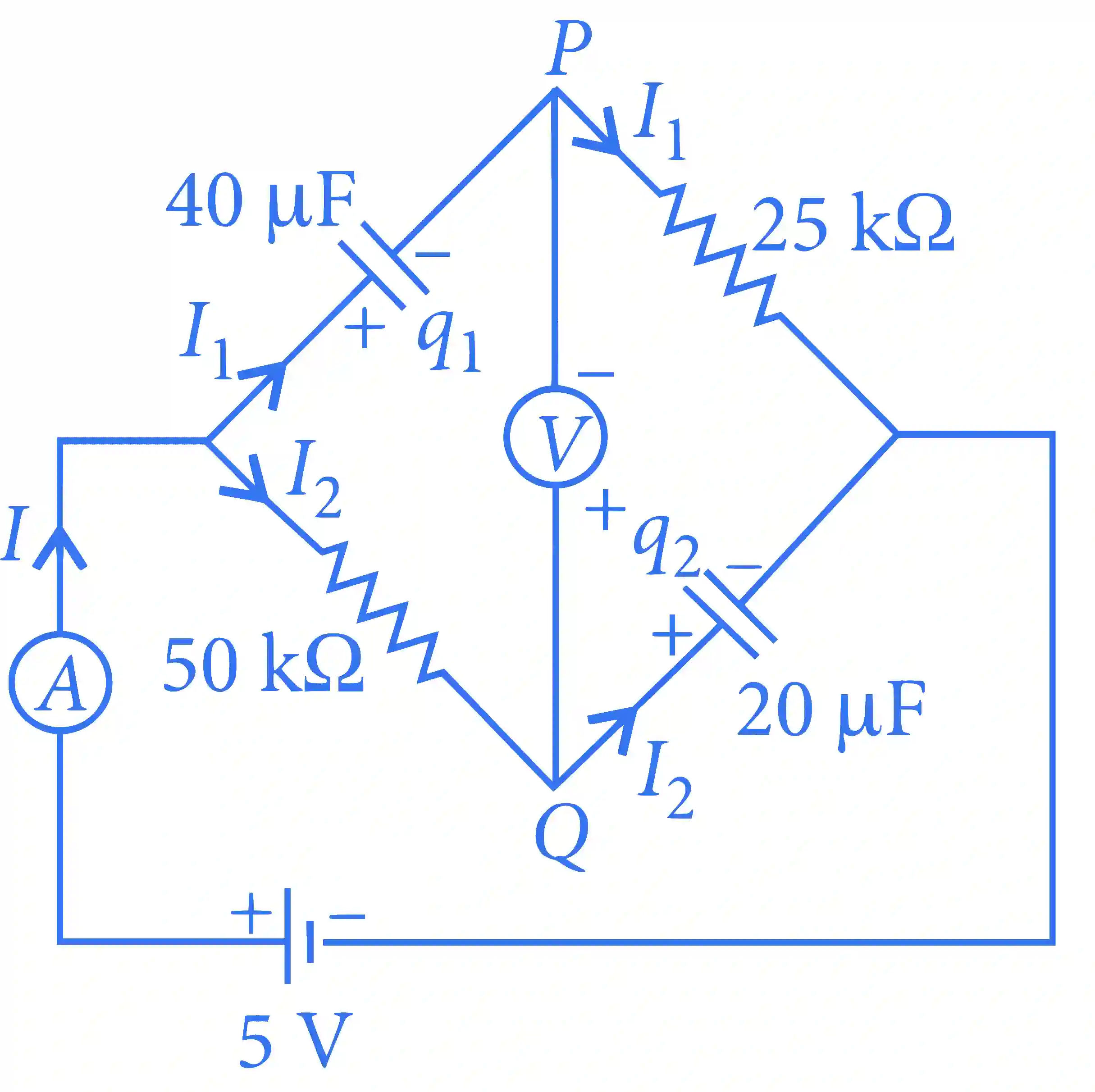
When the key is just pressed, there is no charge on capacitors

∴\therefore 5=25000I1⇒I1=525000=0.2 mA5 = 25000{I_1} \Rightarrow {I_1} = {5 \over {25000}} = 0.2\,mA

and 5=50000I2⇒I2=550000=0.1 mA5 = 50000{I_2} \Rightarrow {I_2} = {5 \over {50000}} = 0.1\,mA

Reading of voltmeter =VQ−VP=−25000I1= {V_Q} - {V_P} = - 25000{I_1}

=−25000×0.2×10−3V=−5V= - 25000 \times 0.2 \times {10^{ - 3}}V = - 5V

After a very long time, steady state is reached, i.e. I1−I2=0{I_1} - {I_2} = 0

∴\therefore 5=q140×10−65 = {{{q_1}} \over {40 \times {{10}^{ - 6}}}} or q1=200μC{q_1} = 200\mu C

and ∴\therefore 5=q220×10−65 = {{{q_2}} \over {20 \times {{10}^{ - 6}}}} or q2=100μC{q_2} = 100\mu C

Now, reading of voltmeter =VQ−VP= {V_Q} - {V_P}

=q220μF=100μC20μF=5V= {{{q_2}} \over {20\mu F}} = {{100\mu C} \over {20\mu F}} = 5V

For capacitor of 40 μ\mu F,

τ1=RC=25×103×40×10−6=1 s{\tau _1} = RC = 25 \times {10^3} \times 40 \times {10^{ - 6}} = 1\,s

and for capacitor of 20 μ\mu F,

τ2=RC=50×103×20×10−6=1 s{\tau _2} = RC = 50 \times {10^3} \times 20 \times {10^{ - 6}} = 1\,s

∴\therefore At any instant t,

q1=200[1−e−t]μC{q_1} = 200[1 - {e^{ - t}}]\mu C , q2=100[1−e−t]μC{q_2} = 100[1 - {e^{ - t}}]\mu C

I1=0.2 e−t{I_1} = 0.2\,{e^{ - t}} mA, I2=0.1 e−t{I_2} = 0.1\,{e^{ - t}} mA

VQ−VP=100(1−e−t)μC20μF−25kΩ×0.2 e−t{V_Q} - {V_P} = {{100(1 - {e^{ - t}})\mu C} \over {20\mu F}} - 25k\Omega \times 0.2\,{e^{ - t}} mA

=5(1−e−t)−5e−t=5−10e−t= 5(1 - {e^{ - t}}) - 5{e^{ - t}} = 5 - 10{e^{ - t}}

At t = ln 2 s; VQ−VP=5−10e−ln⁡2=5−102=0{V_Q} - {V_P} = 5 - 10{e^{ - \ln 2}} = 5 - {{10} \over 2} = 0 V

Initially, I0 = 0.1 mA + 0.2 mA = 0.3 mA

At t = 1 s, I = I1 + I2

=(0.2e−1+0.1e−1)=0.3e mA=I0e= (0.2{e^{ - 1}} + 0.1{e^{ - 1}}) = {{0.3} \over e}\,mA = {{{I_0}} \over e}

After a long time, i.e. t →\to ∞\infty

I=I1+I2=0.2e−∞+0.1e−∞=0I = {I_1} + {I_2} = 0.2{e^{ - \infty }} + 0.1{e^{ - \infty }} = 0

Related Learning Resources & Exam Preparation