Verified Solution • 2025–26 Session
moderate
QJEEAdv16Ph4957: JEE Advanced 2016 Physics - Class 11 JEEAdv16Ph4957 Solution: The ends Q and R of two thin wires, PQ and RS, are soldered…
The ends Q and R of two thin wires, PQ and RS, are soldered (joined) together. Initially each of the wires has a length of 1 m at 10oC. Now the end P is maintained at 10oC, while the end S is heated and maintained at 400oC. The system is thermally insulated from its surroundings. If the thermal conductivity of wire PQ is twice that of the wire RS and the coefficient of linear thermal expansion of PQ is 1.2 10-5 K-1 , the change in length of the wire PQ is
Multiple Choice Options
- A 0.78 mm
- B 0.90 mm
- C 1.56 mm
- D 2.34 mm
Step-by-Step Verified Solution
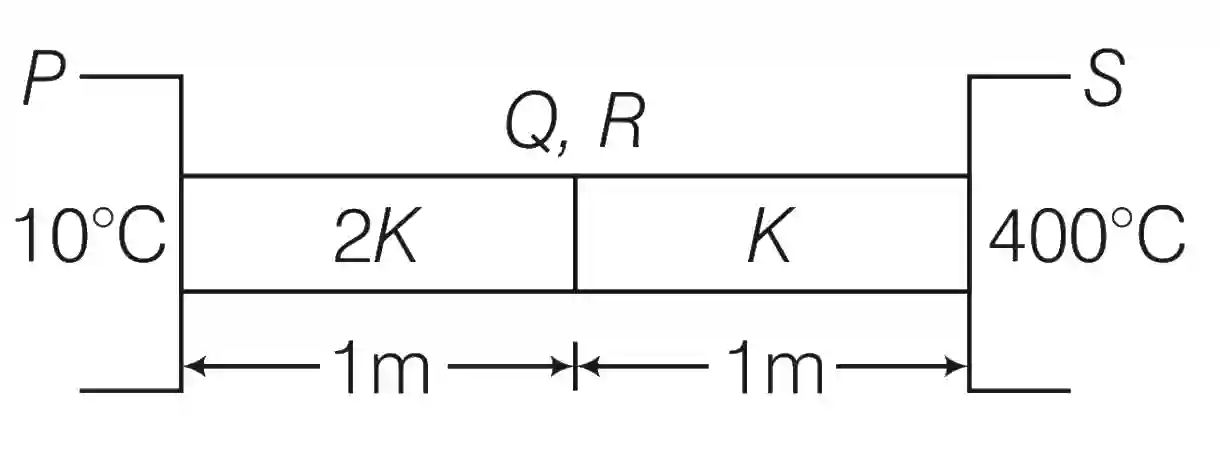
Rate of heat flow from P to Q,
Rate of heat flow from Q to S,
At steady state, state rate of heat flow is same
or or
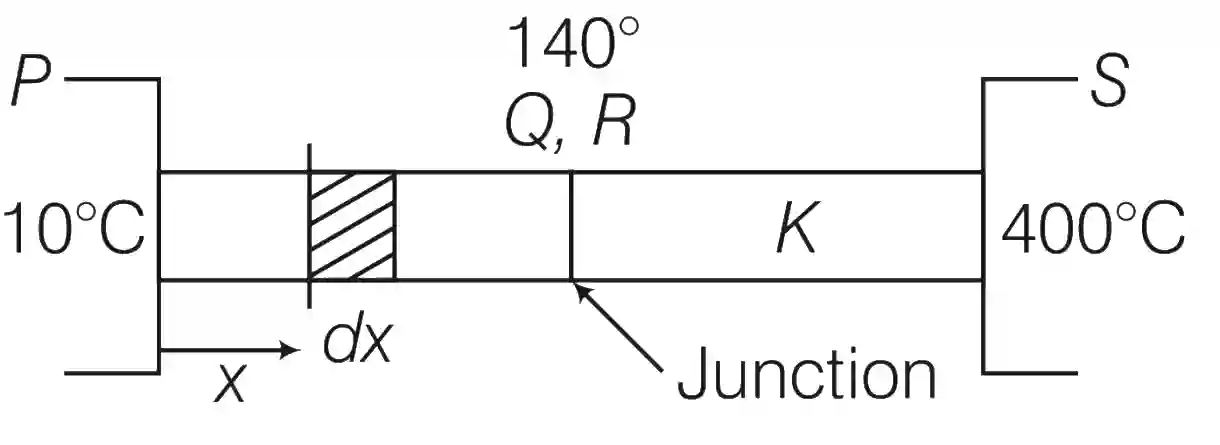
Temperature of junction is C.
Temperature at a distance x from end P is
Change in length dx is suppose dy.
Then,
m = 0.78 mm