Verified Solution • 2025–26 Session
moderate
QJEEAdv16Ph27eb: JEE Advanced 2016 Physics - Class 11 JEEAdv16Ph27eb Solution: A frame of the reference that is accelerated with respect to an …
A frame of the reference that is accelerated with respect to an inertial frame of reference is called a non-inertial frame of reference. A coordinate system fixed on a circular disc rotating about a fixed axis with a constant angular velocity is an example of a non-inertial frame of reference. The relationship between the force rot experienced by a particle of mass m moving on the rotating disc and the force in experienced by the particle in an inertial frame of reference is,
rot = in + 2m ( rot ) + m ( ) ,
where, vrot is the velocity of the particle in the rotating frame of reference and r is the position vector of the particle with respect to the centre of the disc.
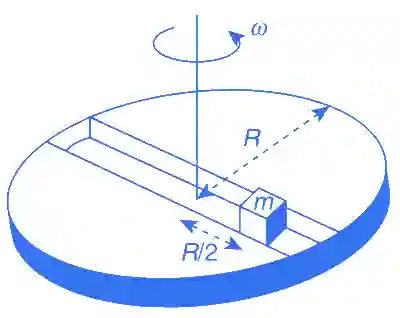
Now, consider a smooth slot along a diameter of a disc of radius R rotating counter-clockwise with a constant angular speed about its vertical axis through its centre. We assign a coordinate system with the origin at the centre of the disc, the X-axis along the slot, the Y-axis perpendicular to the slot and the Z-axis along the rotation axis ( = ). A small block of mass m is gently placed in the slot at r = (R/2) at t = 0 and is constrained to move only along the slot.
The distance r of the block at time t is
rot = in + 2m ( rot ) + m ( ) ,
where, vrot is the velocity of the particle in the rotating frame of reference and r is the position vector of the particle with respect to the centre of the disc.
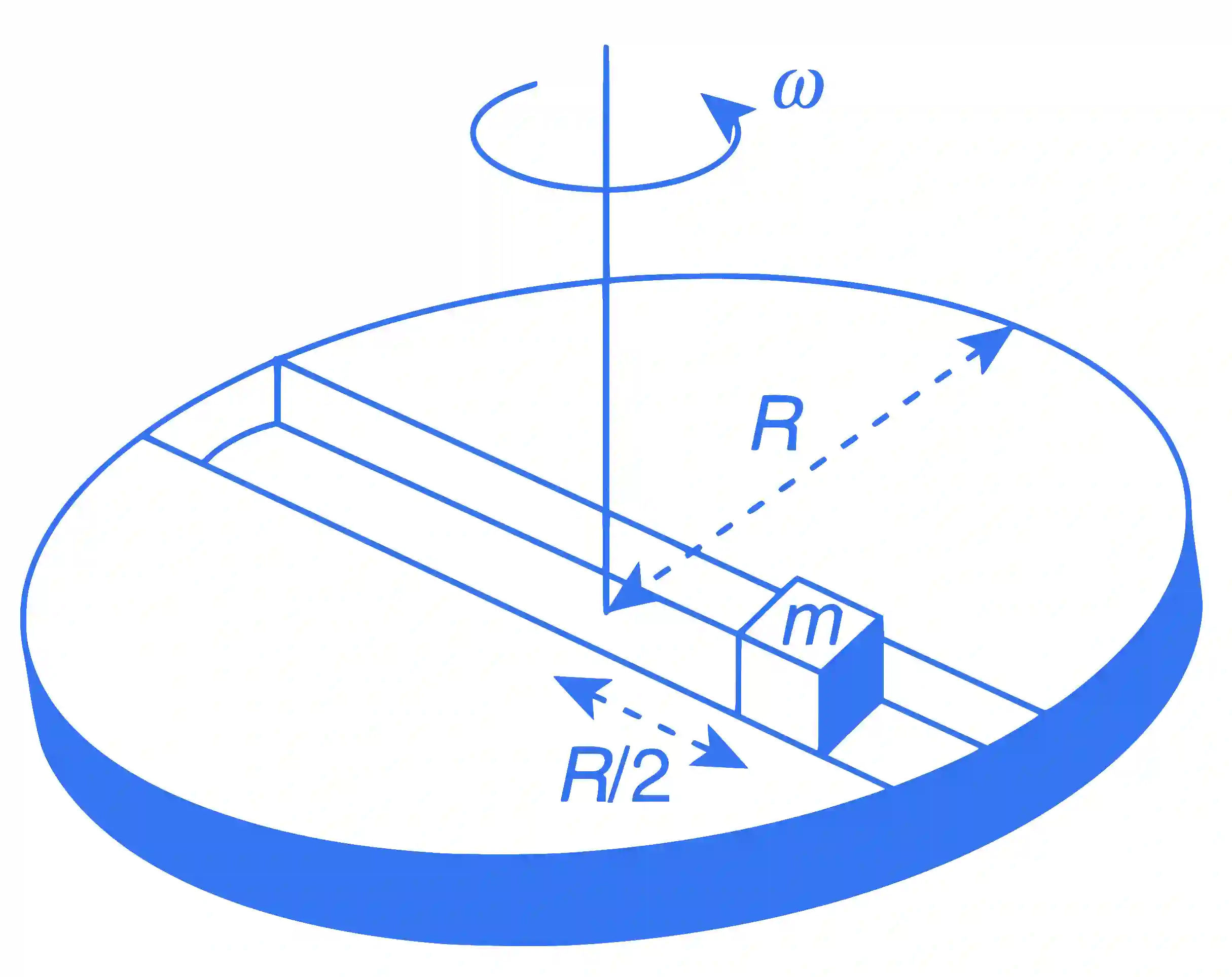
Now, consider a smooth slot along a diameter of a disc of radius R rotating counter-clockwise with a constant angular speed about its vertical axis through its centre. We assign a coordinate system with the origin at the centre of the disc, the X-axis along the slot, the Y-axis perpendicular to the slot and the Z-axis along the rotation axis ( = ). A small block of mass m is gently placed in the slot at r = (R/2) at t = 0 and is constrained to move only along the slot.
The distance r of the block at time t is
Multiple Choice Options
- A
- B
- C
- D
Step-by-Step Verified Solution
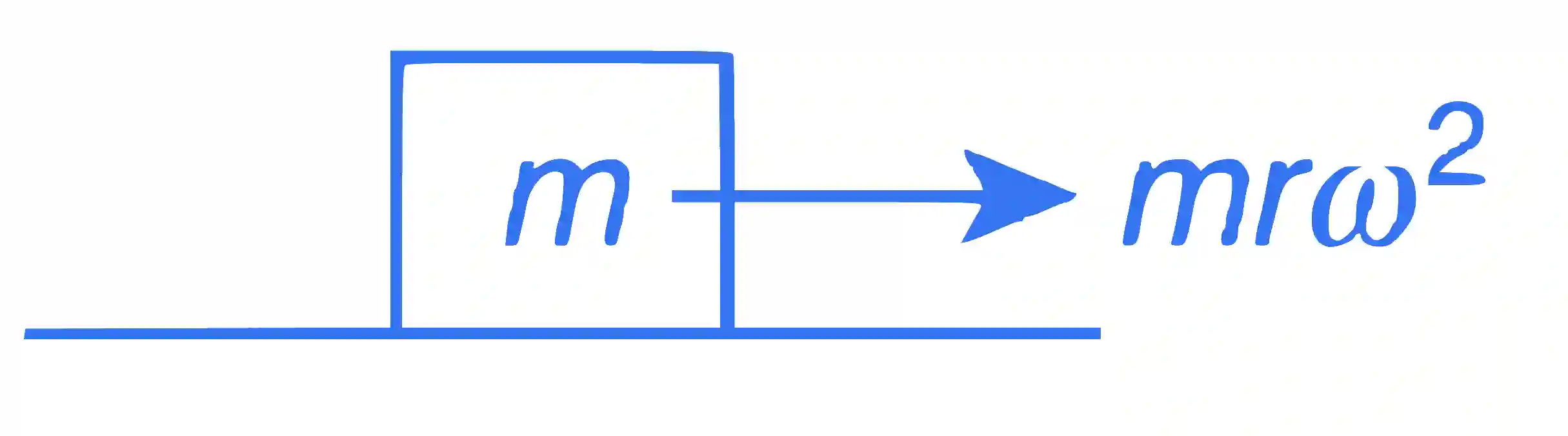
The given particle of mass m experiences a centrifugal force:
F = ma = mr 2
a = r 2
or, ( )
( at t = 0, )
Now,
Therefore,
or, ...... (1)
To solve this integral, we substitute ; therefore,
Let . Therefore,
On replacing x by , we get
or,
Hence, option (c) is correct.