Verified Solution • 2025–26 Session
moderate
QJEEAdv16Maf5d8: JEE Advanced 2016 Mathematics - Class 12 JEEAdv16Maf5d8 Solution: A solution curve of the differential equation passes through…
A solution curve of the differential equation
x>0, passes through the
point . Then the solution curve
x>0, passes through the
point . Then the solution curve
Multiple Choice Options
- A intersects exactly at one point
- B intersects exactly at two points
- C intersects
- D does NOT intersect
Step-by-Step Verified Solution
Options (A) and (B): The given differential equation is
\left[x^2+4 x+4+y(x+2)\right] \frac{d y}{d x}-y^2=0 \quad(x>0)
which is further simplified as follows:
Substituting , we get
Now,
That is,
Let ; therefore,
Now,
which passes through the point . Therefore, from Eq. (1), we get
Substituting , we get
Therefore, (since .
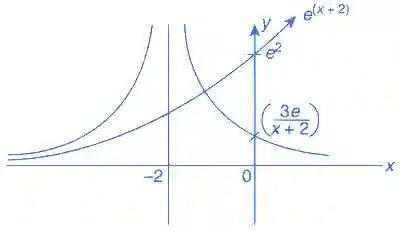
That is, the solution curve intersects exactly at one point and not at two points. Therefore, option (A) is correct and option (B) is incorrect.
Option (C): We have
which meets at two points for x<0 and for x>0 , there is no intersection point.
Hence, option is incorrect.
Option (D): We have
Therefore, there is no intersection point for x>0 . Hence option (D) is correct.
\left[x^2+4 x+4+y(x+2)\right] \frac{d y}{d x}-y^2=0 \quad(x>0)
which is further simplified as follows:
Substituting , we get
Now,
That is,
Let ; therefore,
Now,
which passes through the point . Therefore, from Eq. (1), we get
Substituting , we get
Therefore, (since .
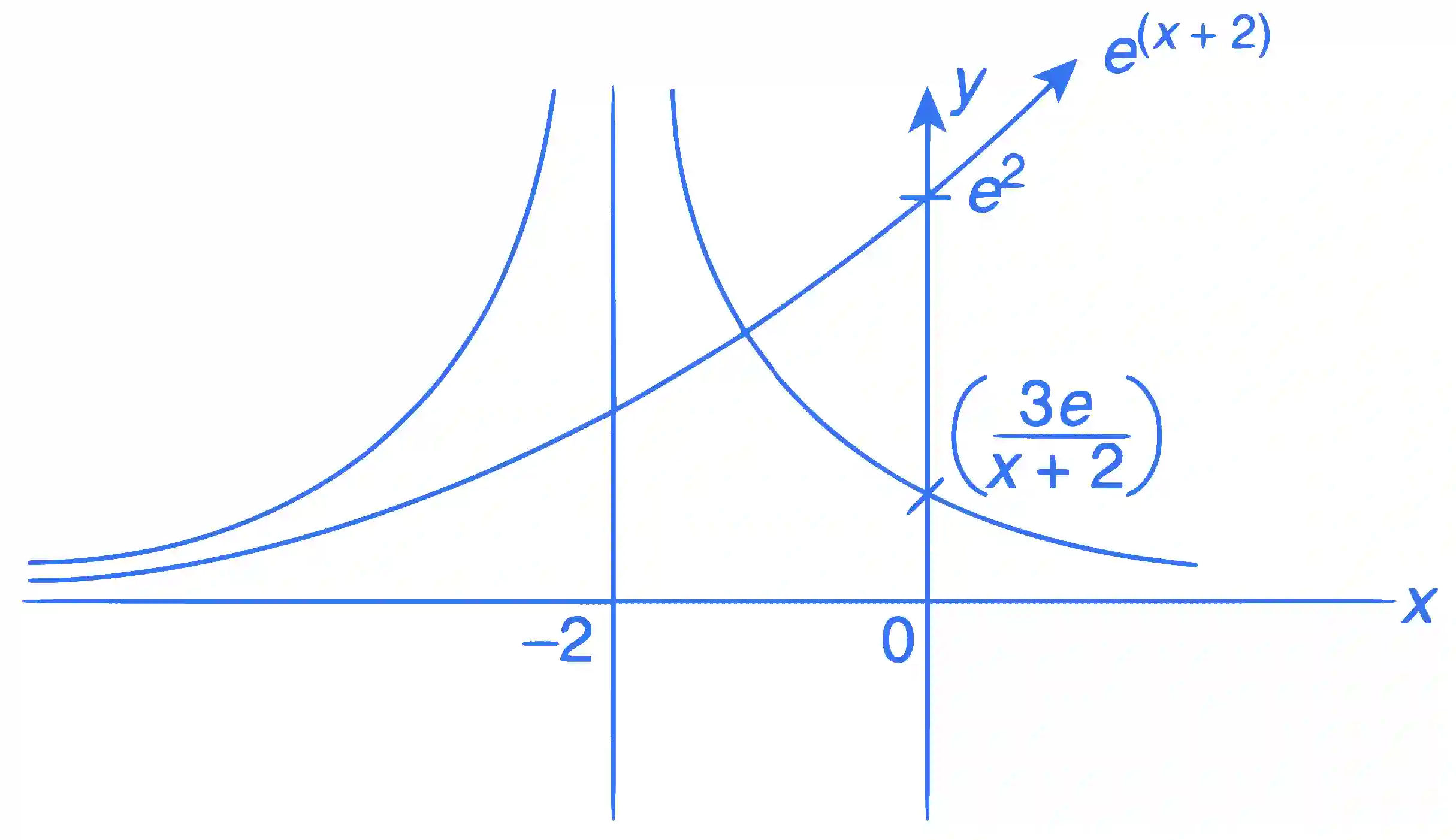
That is, the solution curve intersects exactly at one point and not at two points. Therefore, option (A) is correct and option (B) is incorrect.
Option (C): We have
which meets at two points for x<0 and for x>0 , there is no intersection point.
Hence, option is incorrect.
Option (D): We have
Therefore, there is no intersection point for x>0 . Hence option (D) is correct.