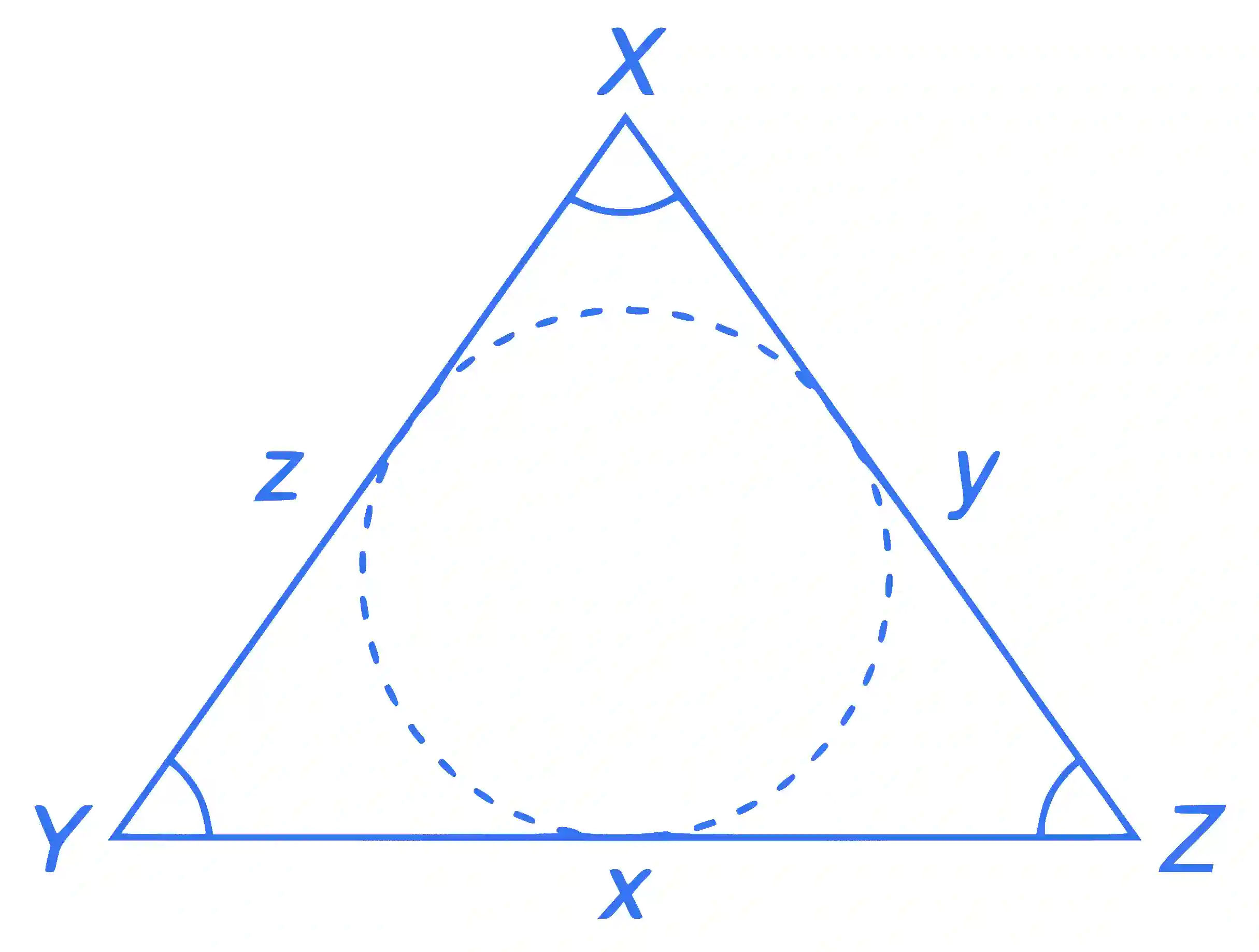
It is given that
2 s = x + y + z 2 s=x+y+z 2 s = x + y + z Let us consider
s − x 4 = s − y 3 = s − z 2 = k \frac{s-x}{4}=\frac{s-y}{3}=\frac{s-z}{2}=k 4 s − x = 3 s − y = 2 s − z = k That is,
s = 4 k + x s=4 k+x s = 4 k + x a m p ; s = 3 k + y a m p ; s = 2 k + z a m p ; 3 s = 9 k + ( x + y + z ) = 9 k + 2 s a m p ; s = 9 k a m p ; x = 9 k − 4 k = 5 k a m p ; y = 6 k , z = 7 k \begin{aligned}&s =3 k+y \\\\&s =2 k+z \\\\&3 s =9 k+(x+y+z)=9 k+2 s \\\\&s =9 k \\\\&x =9 k-4 k=5 k \\\\&y =6 k, z=7 k\end{aligned} am p ; s = 3 k + y am p ; s = 2 k + z am p ; 3 s = 9 k + ( x + y + z ) = 9 k + 2 s am p ; s = 9 k am p ; x = 9 k − 4 k = 5 k am p ; y = 6 k , z = 7 k Area of in-circle of the triangle
X Y Z X Y Z X Y Z is
π r 2 a m p ; = π ( Δ s ) 2 a m p ; = π s 2 Δ 2 = π s 2 s ( s − x ) ( s − y ) ( s − z ) a m p ; = π 81 k 2 × 9 k × 4 k × 3 k × 2 k a m p ; = π 9 k × 24 k 3 = π 9 24 k 2 \begin{aligned}\pi r^2 & =\pi\left(\frac{\Delta}{s}\right)^2 \\\\& =\frac{\pi}{s^2} \Delta^2=\frac{\pi}{s^2} s(s-x)(s-y)(s-z) \\\\& =\frac{\pi}{81 k^2} \times 9 k \times 4 k \times 3 k \times 2 k \\\\& =\frac{\pi}{9 k} \times 24 k^3=\frac{\pi}{9} 24 k^2\end{aligned} π r 2 am p ; = π ( s Δ ) 2 am p ; = s 2 π Δ 2 = s 2 π s ( s − x ) ( s − y ) ( s − z ) am p ; = 81 k 2 π × 9 k × 4 k × 3 k × 2 k am p ; = 9 k π × 24 k 3 = 9 π 24 k 2 a m p ; Therefore, π 9 24 k 2 = 8 π 3 a m p ; ⇒ k 2 = 8 π 3 × 9 24 π = 1 ⇒ k = 1 \begin{aligned}& \text {Therefore, } \frac{\pi}{9} 24 k^2=\frac{8 \pi}{3} \\\\& \Rightarrow \quad k^2=\frac{8 \pi}{3} \times \frac{9}{24 \pi}=1 \Rightarrow k=1\end{aligned} am p ; Therefore, 9 π 24 k 2 = 3 8 π am p ; ⇒ k 2 = 3 8 π × 24 π 9 = 1 ⇒ k = 1 The sides of the triangle is given by
x = 5 , y = 6 , z = 7 x=5, y=6, z=7 x = 5 , y = 6 , z = 7 . Now, the area of
△ X Y Z \triangle X Y Z △ X Y Z is
s ( s − x ) ( s − y ) ( s − z ) = 9 × 4 × 3 × 2 = 6 6 \sqrt{s(s-x)(s-y)(s-z)}=\sqrt{9 \times 4 \times 3 \times 2}=6 \sqrt{6} s ( s − x ) ( s − y ) ( s − z ) = 9 × 4 × 3 × 2 = 6 6 Hence, option
( A ) (\mathrm{A}) ( A ) is correct.
Now,
R = x y z 4 Δ = 5 × 6 × 7 4 × 6 6 = 35 4 6 R=\frac{x y z}{4 \Delta}=\frac{5 \times 6 \times 7}{4 \times 6 \sqrt{6}}=\frac{35}{4 \sqrt{6}} R = 4Δ x yz = 4 × 6 6 5 × 6 × 7 = 4 6 35 a m p ; sin X 2 sin Y 2 sin Z 2 a m p ; = [ ( s − y ) ( s − z ) y z ] [ ( s − z ) ( s − z ) x z ] [ ( s − y ) ( s − x ) x y ] a m p ; = ( s − z ) ( s − y ) ( s − z ) x y z a m p ; Now, ( s − z ) ( s − y ) ( s − z ) x y z = 4 × 3 × 2 5 × 6 × 7 = 4 25 \begin{aligned}& \sin \frac{X}{2} \sin \frac{Y}{2} \sin \frac{Z}{2} \\\\& \left.\quad=\sqrt{\left[\frac{(s-y)(s-z)}{y z}\right]\left[\frac{(s-z)(s-z)}{x z}\right]\left[\frac{(s-y)(s-x)}{x y}\right]}\right. \\\\& \quad=\frac{(s-z)(s-y)(s-z)}{x y z} \\\\& \text {Now, } \frac{(s-z)(s-y)(s-z)}{x y z}=\frac{4 \times 3 \times 2}{5 \times 6 \times 7}=\frac{4}{25}\end{aligned} am p ; sin 2 X sin 2 Y sin 2 Z am p ; = [ yz ( s − y ) ( s − z ) ] [ x z ( s − z ) ( s − z ) ] [ x y ( s − y ) ( s − x ) ] am p ; = x yz ( s − z ) ( s − y ) ( s − z ) am p ; Now, x yz ( s − z ) ( s − y ) ( s − z ) = 5 × 6 × 7 4 × 3 × 2 = 25 4 Hence, option (C) is correct.
Now,
sin 2 ( X + Y 2 ) = sin 2 ( π − Z 2 ) = cos 2 z 2 = s ( s − z ) x y \sin ^2\left(\frac{X+Y}{2}\right)=\sin ^2\left(\frac{\pi-Z}{2}\right)=\cos ^2 \frac{z}{2}=\frac{s(s-z)}{x y} sin 2 ( 2 X + Y ) = sin 2 ( 2 π − Z ) = cos 2 2 z = x y s ( s − z ) = 9 × 2 5 × 6 = 3 5 =\frac{9 \times 2}{5 \times 6}=\frac{3}{5} = 5 × 6 9 × 2 = 5 3 Hence, option (D) is correct.