Verified Solution • 2025–26 Session
moderate
QJEEAdv16Ch0981: JEE Advanced 2016 Chemistry - Class 12 JEEAdv16Ch0981 Solution: A plot of the number of neutrons (N) against the number of…
A plot of the number of neutrons (N) against the number of protons (P) of stable nuclei exhibits upward deviation from linearity for atomic number, Z > 20. For an unstable nucleus having N/P ratio less than 1, the possible mode(s) of decay is(are)
Multiple Choice Options
- A β−-decay ( β emission)
- B orbital or K-electron capture
- C neutron emission
- D β+-decay (positron emission)
Step-by-Step Verified Solution
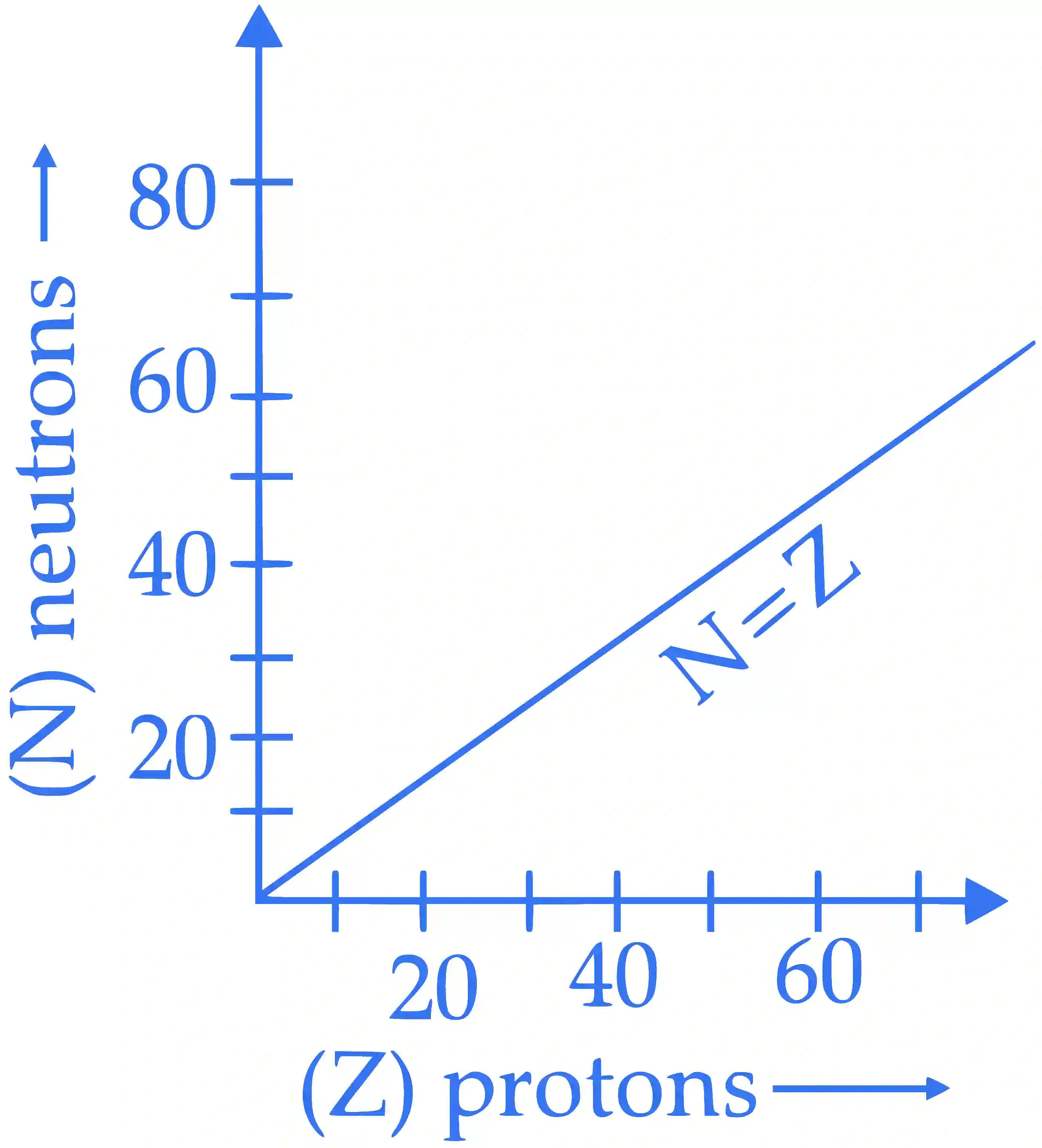
Plot of Z (number of protons) verses N (number of neutrons) is represented as :

(a) For a stable nucleus should be equal to 1.
This happens for elements till atomic number . For such nucleus number of proton are equal to number of neutrons.
(b) For heavier nucleides with atomic number greater than 20(Z>20) , the number of neutron are more than proton as seen by curved (green) appearance in the plot.
(c) For nucleids with \mathrm{N} / \mathrm{Z}<1 , the number of neutrons are less than the protons making the nucleus unstable. This is due to increase in coulombic repulsions between positively charged protons.
Such nuclei become stable by K-electron capture and positron emission.
K-electron capture :
The K-electron capture, proton is converted to the neutron as increases the ratio.
decay (positron emission) :
Proton decays to a neutron, positron and electron nutrino. This decreases the number of protons and increases the number of neutrons, thereby increasing ratio.
Options (B) and (D) are correct.
(a) For a stable nucleus should be equal to 1.
This happens for elements till atomic number . For such nucleus number of proton are equal to number of neutrons.
(b) For heavier nucleides with atomic number greater than 20(Z>20) , the number of neutron are more than proton as seen by curved (green) appearance in the plot.
(c) For nucleids with \mathrm{N} / \mathrm{Z}<1 , the number of neutrons are less than the protons making the nucleus unstable. This is due to increase in coulombic repulsions between positively charged protons.
Such nuclei become stable by K-electron capture and positron emission.
K-electron capture :
The K-electron capture, proton is converted to the neutron as increases the ratio.
decay (positron emission) :
Proton decays to a neutron, positron and electron nutrino. This decreases the number of protons and increases the number of neutrons, thereby increasing ratio.
Options (B) and (D) are correct.