QJEEAdv15Phfcd6: JEE Advanced 2015 Physics - Class 12 JEEAdv15Phfcd6 Solution: Match the nuclear processes given in Column I with the…
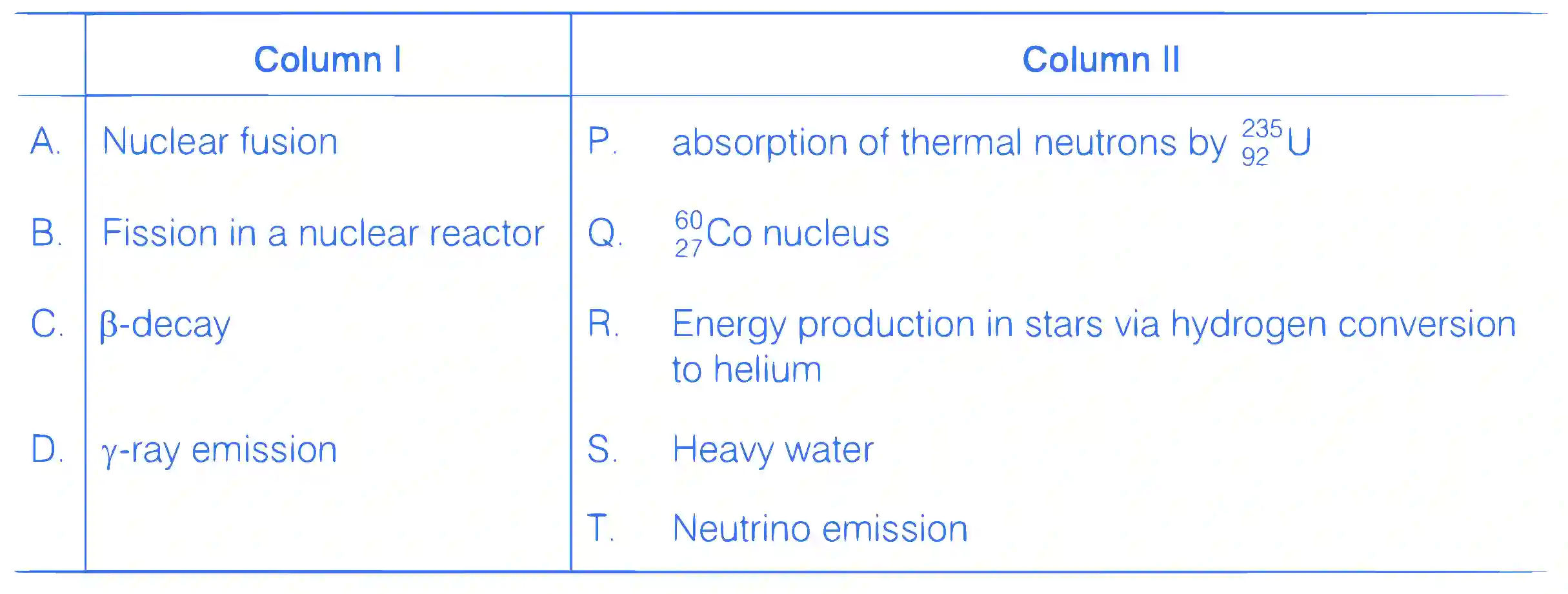
Match the nuclear processes given in Column I with the appropriate option(s) in Column II:
Multiple Choice Options
- A (A)→(R) or (RT), (T); (B)→(P), (S); (C)→(Q), (T); (D)→(R)
- B (A)→(R), (T); (B)→(Q), (S); (C)→(Q), (T); (D)→(R)
- C (A)→(R) or (RT), (T); (B)→(P), (S); (C)→(S), (T); (D)→(R)
- D (A)→(P), (T); (B)→(P), (S); (C)→(Q), (T); (D)→(R)
Step-by-Step Verified Solution
The nuclear fusion is responsible for energy production in stars via fusion of hydrogen nuclei into helium nuclei. In sun, the fusion takes place dominantly by proton-proton cycle, . The neutrino ( ) and -rays emissions are parts of this fusion reaction.
The uranium based fission reactions involve absorption of thermal neutrons by U nuclei to produce the highly fissionable U nuclei. This nuclei then fissions into two parts e.g., U I + Y + 2n. The fission fragments are unstable and undergo -decay to reduce their neutron to proton ratio. The fragments are generally formed in excited states and consequently emit -rays. The heavy water (D2O) is used as a moderator to slow down the fast moving neutrons.
In -decay, a neutron is converted into a proton. In this process, an electron and an antineutrino are created and emitted from the nucleus, n p + e + . The -decay in Co Ni + e + . The daughter nuclei Ni is formed in excited state and comes to ground state by -ray emission.
The -rays are high energy electromagnetic rays. These rays are generally emitted when a nuclei in excited state (high energy) makes a transition to a lower state (low energy).