Verified Solution • 2025–26 Session moderate

QJEEAdv15Phf836: JEE Advanced 2015 Physics - Class 11 JEEAdv15Phf836 Solution: A spherical body of radius R consists of a fluid of constant…

A spherical body of radius R consists of a fluid of constant density and is in equilibrium under its own gravity. If P(r) is the pressure at r (r < R), then the correct option(s) is(are)

Multiple Choice Options

  • A P(r=0)=0P(r = 0) = 0
  • B P(r=3R/4)P(r=2R/3)=6380{{P(r = 3R/4)} \over {P(r = 2R/3)}} = {{63} \over {80}}
  • C P(r=3R/5)P(r=2R/5)=1621{{P(r = 3R/5)} \over {P(r = 2R/5)}} = {{16} \over {21}}
  • D P(r=R/2)P(r=R/3)=2027{{P(r = R/2)} \over {P(r = R/3)}} = {{20} \over {27}}

Step-by-Step Verified Solution

The acceleration due to gravity at a radial distance r (r < R) from the centre of a sphere of constant mass density ρ\rho is given by

g=G(43πr3)ρr2=4πρG3rg = {{G\left( {{4 \over 3}\pi {r^3}} \right)\rho } \over {{r^2}}} = {{4\pi \rho G} \over 3}r .

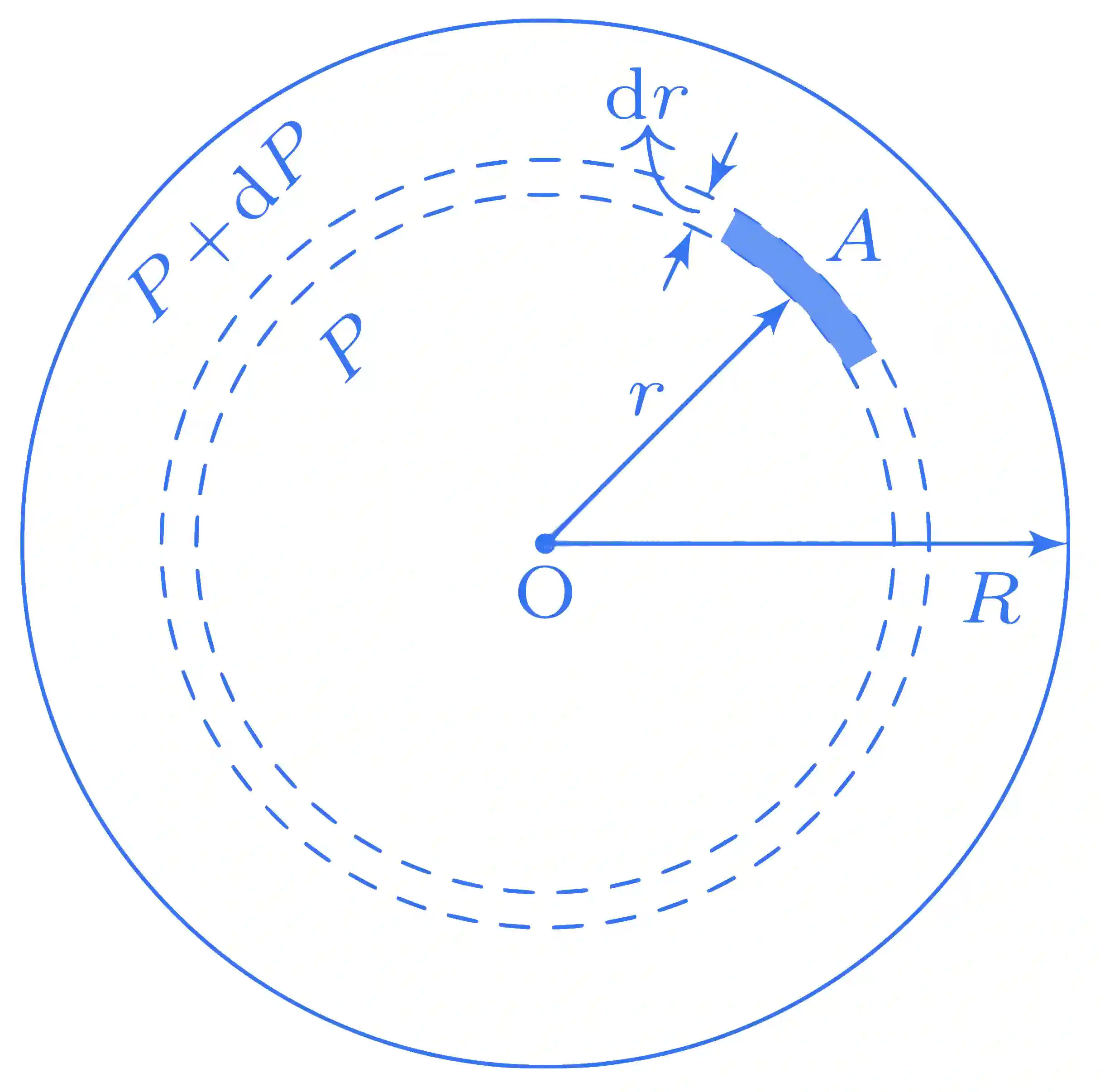
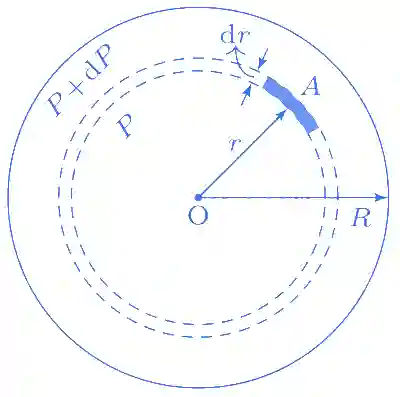
Consider a spherical shell of radius r and thickness dr.
JEE Advanced 2015 Paper 2 Offline Physics - Properties of Matter Question 45 English Explanation

Let P and P + dP be the fluid pressures inside and outside the shell. Consider a small element of area A and mass dm=ρAdrdm = \rho Adr on the shell. The forces on this element are gravitational force (dm g) direted inwards, the force due to pressure of the fluid outside the shell ((P+dP)A)((P + dP)A) directed inwards, and the force due to pressure of the fluid inside the shell (PA) directed outwards. In equilibrium, net force on the element is zero, i.e.,

(ρAdr)43πρGr+(P+dP)A=PA(\rho Adr){4 \over 3}\pi \rho Gr + (P + dP)A = PA , or

dP=−43πGρ2r drdP = - {4 \over 3}\pi G{\rho ^2}r\,dr .

Note that the pressure decreases with increase in r. The pressure is zero at the surface of the sphere i.e., P = 0 at r = R. Integrate to get

∫0P(r)dP=P(r)=−43πGρ2∫Rrrdr\int_0^{P(r)} {dP = P(r) = - {4 \over 3}\pi G{\rho ^2}\int_R^r {rdr} }

=23πGρ2(R2−r2)= {2 \over 3}\pi G{\rho ^2}({R^2} - {r^2}) .

Now, P(r=0)=2π3ρ2GR2≠0P(r = 0) = {{2\pi } \over 3}{\rho ^2}G{R^2} \ne 0

P(r=3R/4)P(r=2R/3)=R2−(3R/4)2R2−(2R/3)2=716×95=6380{{P(r = 3R/4)} \over {P(r = 2R/3)}} = {{{R^2} - {{(3R/4)}^2}} \over {{R^2} - {{(2R/3)}^2}}} = {7 \over {16}} \times {9 \over 5} = {{63} \over {80}}

P(r=3R/5)P(r=2R/5)=R2−(3R/5)2R2−(2R/5)2=1625×2521=1621{{P(r = 3R/5)} \over {P(r = 2R/5)}} = {{{R^2} - {{(3R/5)}^2}} \over {{R^2} - {{(2R/5)}^2}}} = {{16} \over {25}} \times {{25} \over {21}} = {{16} \over {21}}

P(r=R/2)P(r=R/3)=R2−(R/2)2R2−(R/3)2=34×98=2732≠2027{{P(r = R/2)} \over {P(r = R/3)}} = {{{R^2} - {{(R/2)}^2}} \over {{R^2} - {{(R/3)}^2}}} = {3 \over 4} \times {9 \over 8} = {{27} \over {32}} \ne {{20} \over {27}}

Related Learning Resources & Exam Preparation