Verified Solution • 2025–26 Session moderate

QJEEAdv15Phc513: JEE Advanced 2015 Physics - Class 12 JEEAdv15Phc513 Solution: Consider a uniform spherical charge distribution of radius…
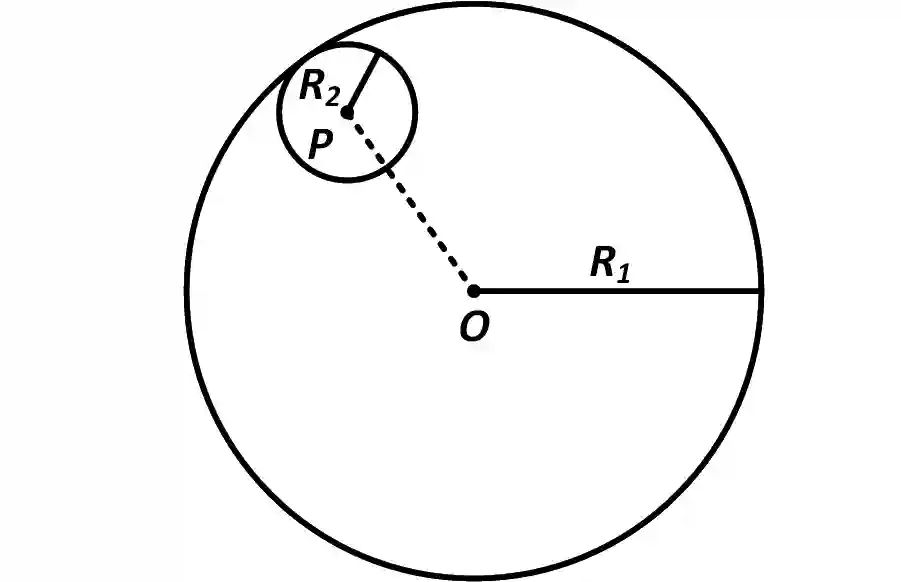
Consider a uniform spherical charge distribution of radius R1{R_1} centred at the origin O.O. In this distribution, a spherical cavity of radius R2,{R_2}, centred at PP with distance OP=aOP=a =R1−R2= {R_1} - {R_2} (see figure) is made. If the electric field inside the cavity at position r→\overrightarrow r is E→(r)→,\overrightarrow E \overrightarrow {\left( r \right)} , then the correct statement(s) is (are)

JEE Advanced 2015 Paper 2 Offline Physics - Electrostatics Question 43 English

Multiple Choice Options

  • A E→\overrightarrow E is uniform, its magnitude is independent of R2{R_2} but its direction depends on r→.\overrightarrow r .
  • B E→\overrightarrow E is uniform, its magnitude depends on R2{R_2} and its direction depends on r→.\overrightarrow r .
  • C E→\overrightarrow E is uniform, its magnitude is independent of a but its direction depends on a→\overrightarrow a
  • D E→\overrightarrow E is uniform and both its magnitude and direction depend on a→\overrightarrow a

Step-by-Step Verified Solution

Let ρ\rho be the charge density of the spherical charge distribution of radius r1 centred at the origin O. A spherical cavity of radius r2 centred at P with distance OP = a = r1 −- r2 is made in the spherical charge distribution.
JEE Advanced 2015 Paper 2 Offline Physics - Electrostatics Question 43 English Explanation

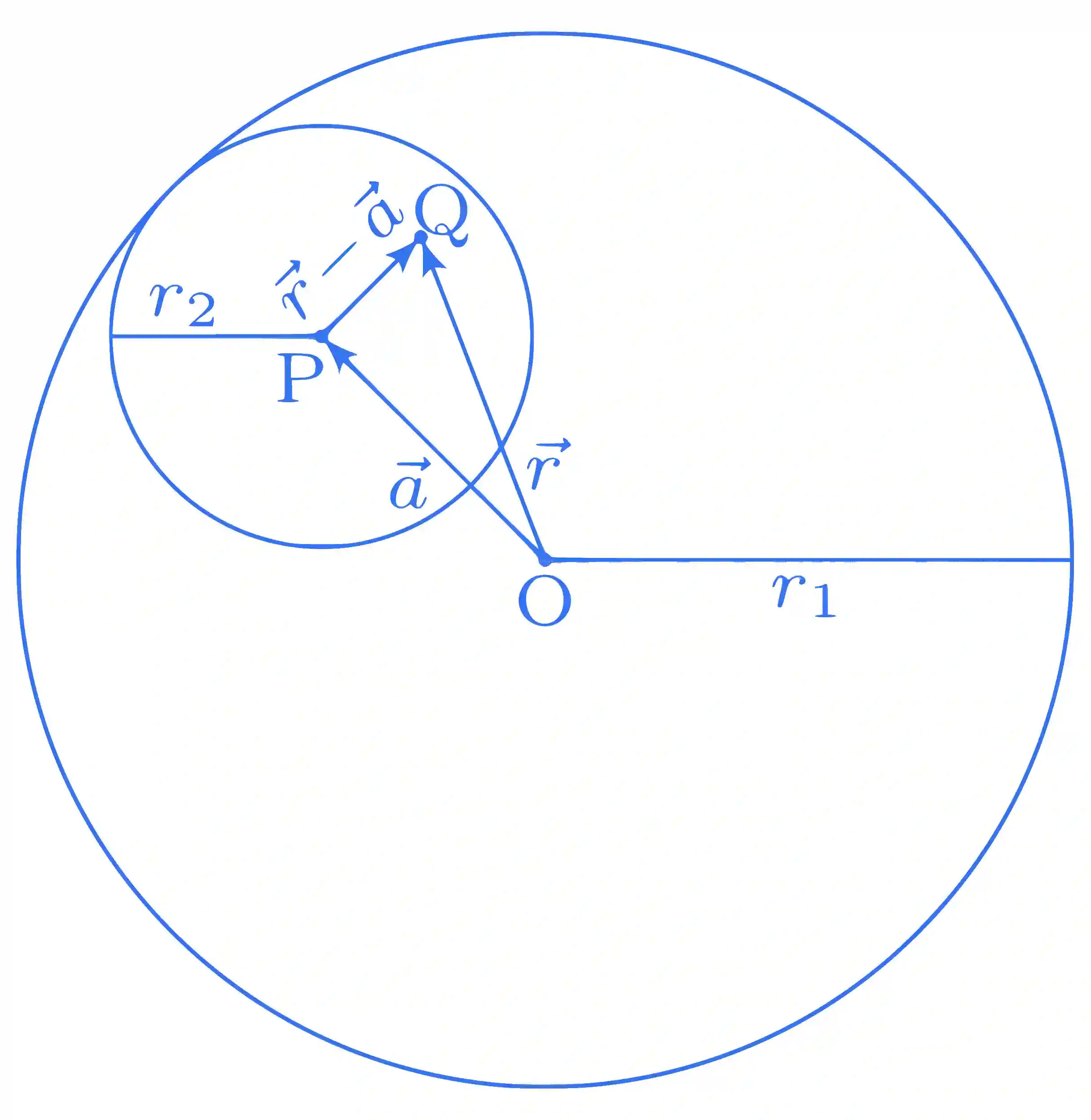
The sphere with cavity is equivalent to a sphere of uniform charge density −- ρ\rho and radius r2 centred at P embedded in the original sphere. Thus, the electric field at a point Q in the cavity is superposition of (i) electric field at Q due to the sphere of charge density ρ\rho and radius r1 centred at O (say E→\overrightarrow E 1), and (ii) electric field at Q due to the sphere of charge density −- ρ\rho and radius r2 centred at P (say E→\overrightarrow E 2). Let a→\overrightarrow a , r→\overrightarrow r , and r→\overrightarrow r −- a→\overrightarrow a be the vectors as shown in the figure. The electric fields E→\overrightarrow E 1, E→\overrightarrow E 2, and their superposition E→\overrightarrow E 12 are given by

E→1=14π∈043π∣r→∣3ρ∣r→∣2r^=ρ3∈0r→{\overrightarrow E _1} = {1 \over {4\pi { \in _0}}}{{{4 \over 3}\pi |\overrightarrow r {|^3}\rho } \over {|\overrightarrow r {|^2}}}\widehat r = {\rho \over {3{ \in _0}}}\overrightarrow r ,

E→2=−ρ3∈0(r→−a→){\overrightarrow E _2} = - {\rho \over {3{ \in _0}}}(\overrightarrow r - \overrightarrow a ) ,

E→12=E→1+E→2=ρ3∈0a→{\overrightarrow E _{12}} = {\overrightarrow E _1} + {\overrightarrow E _2} = {\rho \over {3{ \in _0}}}\overrightarrow a .

Thus, the electric field at a point within the cavity is uniform and its magnitude and direction both depend on a→\overrightarrow a .

Related Learning Resources & Exam Preparation