Verified Solution • 2025–26 Session moderate

QJEEAdv15Ph8274: JEE Advanced 2015 Physics - Class 11 JEEAdv15Ph8274 Solution: An ideal monoatomic gas is confined in a horizontal cylinder by …

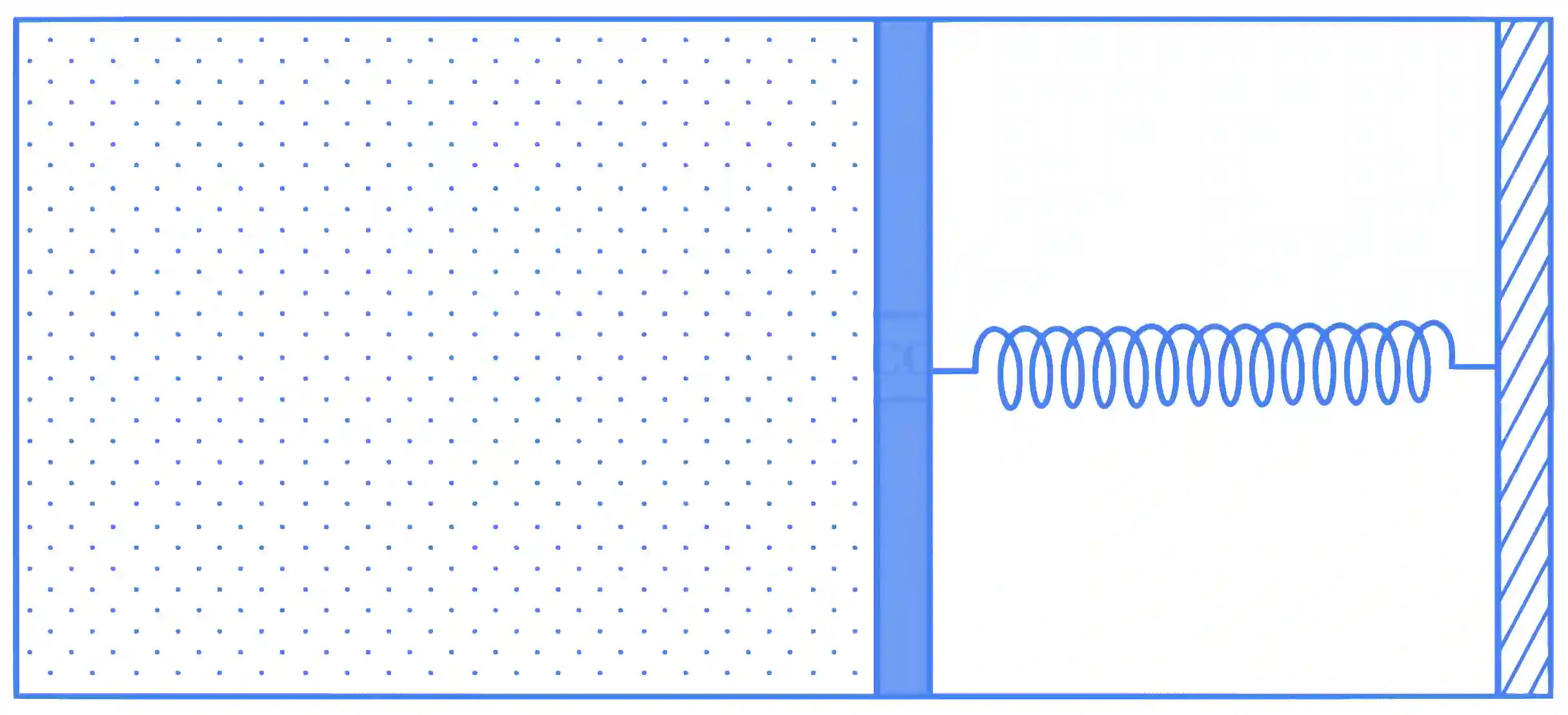
An ideal monoatomic gas is confined in a horizontal cylinder by a spring loaded piston (as shown in the figure). Initially the gas is at temperature T1, pressure P1 and volume V1 and the spring is in its relaxed state. The gas is then heated very slowly to temperature T2, pressure P2 and volume V2. During this process the piston moves out by a distance x.

Ignoring the friction between the piston and the cylinder, the correct statements is/are

JEE Advanced 2015 Paper 2 Offline Physics - Heat and Thermodynamics Question 35 English

Multiple Choice Options

  • A If V2 = 2V1 and T2 = 3Tl, then the energy stored in the spring is 14P1V1{1 \over 4}{P_1}{V_1}
  • B If V2 = 2V1 and T2 = 3T1, then the change in internal energy is 3P1V13{P_1}{V_1}
  • C If V2 = 3V1 and T2 = 4T1, then the work done by the gas is 73P1V1{7 \over 3}{P_1}{V_1}
  • D If V2 = 3V1 and T2 = 4T1, then the heat supplied to the gas is 176P1V1{17 \over 6}{P_1}{V_1}

Step-by-Step Verified Solution

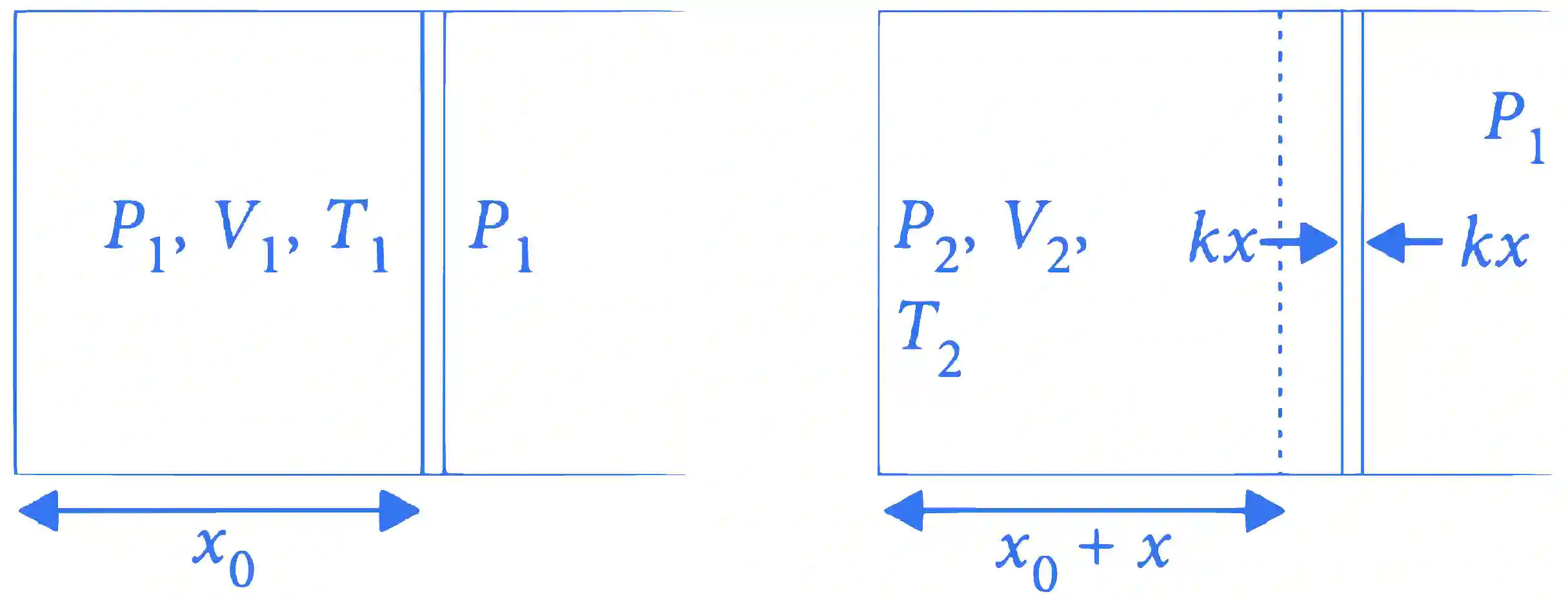
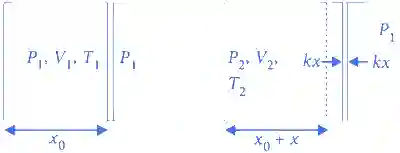
Initially both the compartments has same pressure as they are in equilibrium.
JEE Advanced 2015 Paper 2 Offline Physics - Heat and Thermodynamics Question 35 English Explanation

Suppose spring is compressed by x on heating the gas.

Let A be the area of cross-section of piston. As gas is ideal monoatomic, so

P1V1T1=P2V2T2{{{P_1}{V_1}} \over {{T_1}}} = {{{P_2}{V_2}} \over {{T_2}}} ...... (i)

Force on spring by gas = kx

∴\therefore P2=P1+kxA{P_2} = {P_1} + {{kx} \over A} ...... (ii)

Case I : When V2=2V1{V_2} = 2{V_1} , T2=3T1{T_2} = 3{T_1}

From Eqn. (i)

P1V1T1=P2(2V1)3T1⇒P2=32P1{{{P_1}{V_1}} \over {{T_1}}} = {{{P_2}(2{V_1})} \over {3{T_1}}} \Rightarrow {P_2} = {3 \over 2}{P_1}

Putting this value in eqn. (ii) we get

32P1=P1+kxA⇒kx=P1A2{3 \over 2}{P_1} = {P_1} + {{kx} \over A} \Rightarrow kx = {{{P_1}A} \over 2}

x=V2−V1A=2V1−V1A=V1Ax = {{{V_2} - {V_1}} \over A} = {{2{V_1} - {V_1}} \over A} = {{{V_1}} \over A}

Energy stored in the spring

=12kx2=12(kx)(x)=P1V14= {1 \over 2}k{x^2} = {1 \over 2}(kx)(x) = {{{P_1}{V_1}} \over 4}

So, option (a) is correct.

Change in internal energy,

ΔU=f2(P2V2−P1V1)=32(32P1×2V1−P1V1)=3P1V1\Delta U = {f \over 2}({P_2}{V_2} - {P_1}{V_1}) = {3 \over 2}\left( {{3 \over 2}{P_1} \times 2{V_1} - {P_1}{V_1}} \right) = 3{P_1}{V_1}

So, option (b) is correct.

Case II : When V2=3V1{V_2} = 3{V_1} and T2=4T1{T_2} = 4{T_1}

From Eqn. (i),

P1V1T1=P2(3V1)4T1⇒P2=43P1{{{P_1}{V_1}} \over {{T_1}}} = {{{P_2}(3{V_1})} \over {4{T_1}}} \Rightarrow {P_2} = {4 \over 3}{P_1}

x=V2−V1A=2V1Ax = {{{V_2} - {V_1}} \over A} = {{2{V_1}} \over A}

From eqn. (ii),

43P1=P1+kxA⇒kx=P1A3{4 \over 3}{P_1} = {P_1} + {{kx} \over A} \Rightarrow kx = {{{P_1}A} \over 3}

Gas is heated very slowly so pressure on the other compartment remains same.

Work done by gas = Work done by gas on atmosphere + Energy stored in spring.

Wg=P1Ax+12kx2=P1(2V1)+12(P1A3)(2V1A){W_g} = {P_1}Ax + {1 \over 2}k{x^2} = {P_1}(2{V_1}) + {1 \over 2}\left( {{{{P_1}A} \over 3}} \right)\left( {{{2{V_1}} \over A}} \right)

=2P1V1+13P1V1=73P1V1= 2{P_1}{V_1} + {1 \over 3}{P_1}{V_1} = {7 \over 3}{P_1}{V_1}

So, option (c) is correct.

Heat supplied to the gas,

ΔQ=Wg+ΔU\Delta Q = {W_g} + \Delta U

=73P1V1+32(P2V2−P1V1)= {7 \over 3}{P_1}{V_1} + {3 \over 2}({P_2}{V_2} - {P_1}{V_1})

=73P1V1+32(43P1×3V1−P1V1)= {7 \over 3}{P_1}{V_1} + {3 \over 2}\left( {{4 \over 3}{P_1} \times 3{V_1} - {P_1}{V_1}} \right)

=73P1V1+92P1V1=416P1V1= {7 \over 3}{P_1}{V_1} + {9 \over 2}{P_1}{V_1} = {{41} \over 6}{P_1}{V_1}

So, option (d) is incorrect.

Related Learning Resources & Exam Preparation