Verified Solution • 2025–26 Session moderate

QJEEAdv15Ma5e98: JEE Advanced 2015 Mathematics - Class 12 JEEAdv15Ma5e98 Solution: A cylindrical container is to be made from certain solid…

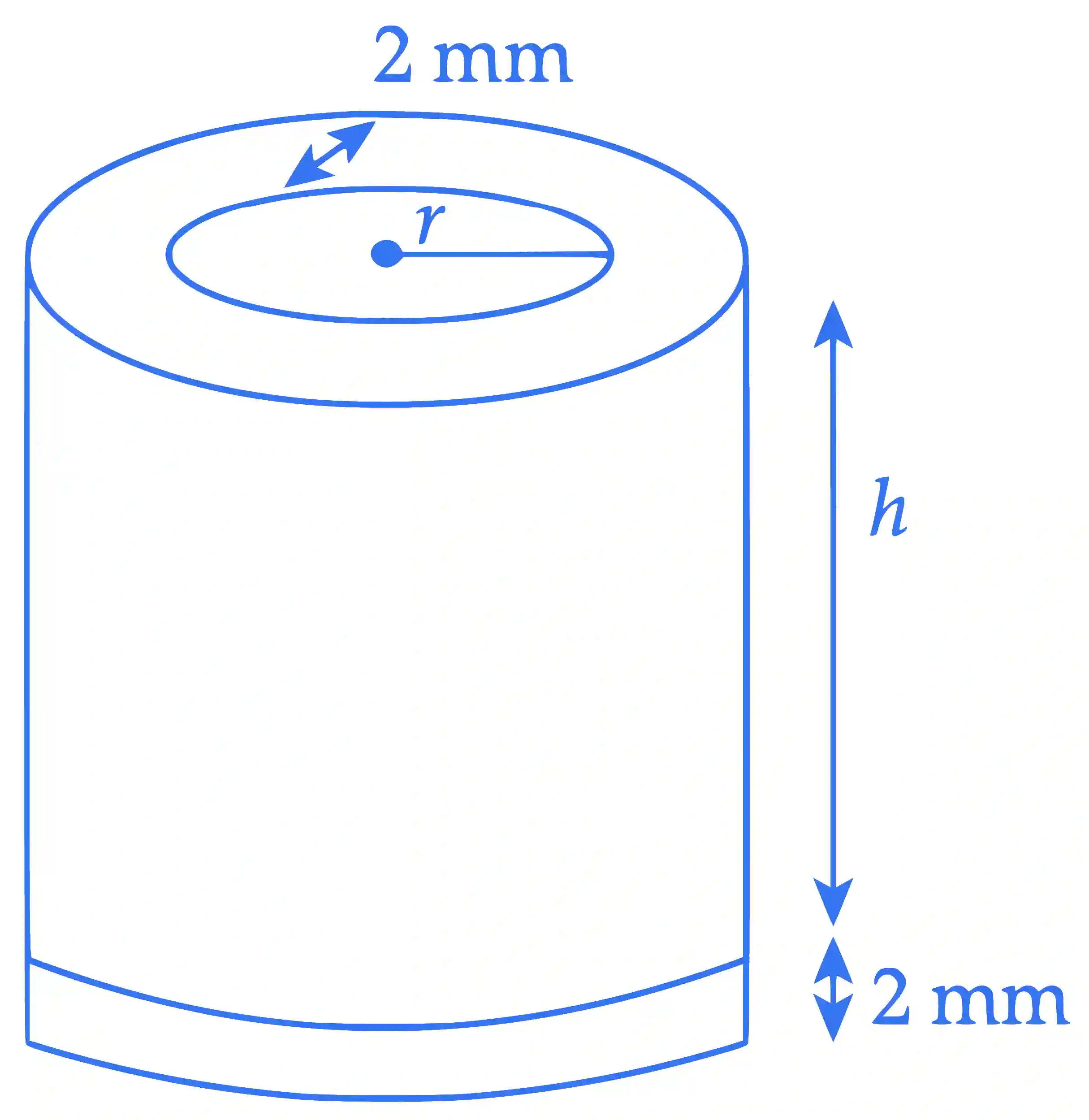
A cylindrical container is to be made from certain solid material with the following constraints: It has a fixed inner volume of VV mm3m{m^3} , has a 22 mm thick solid wall and is open at the top. The bottom of the container is a solid circular disc of thickness 22 mm and is of radius equal to the outer radius of the container.

If the volume of the material used to make the container is minimum when the inner radius of the container is 1010 mm,
then the value of V250π{V \over {250\pi }} is

Step-by-Step Verified Solution

Given: The inner volume of cylinder =Vmm3=\mathrm{Vmm}^3
JEE Advanced 2015 Paper 1 Offline Mathematics - Application of Derivatives Question 14 English Explanation
Thickness of wall =2 mm=2 \mathrm{~mm}

Thickness of bottom circular disc =2 mm=2 \mathrm{~mm}

Let the inner radius of cylinder =r mm=r \mathrm{~mm} and height of the inner cylinder =h mm=h \mathrm{~mm} .

⇒V=πr2h\Rightarrow \mathrm{V}=\pi r^2 h

Now, volume of the material used == volume of outer cylinder - volume of the inner cylinder + Volume of the circular disc

⇒Vm=π(r+2)2h−πr2h+π(r+2)22⇒Vm=πh{(r+2)2−r2}+2π(r+2)2⇒Vm=πh(4r+4)+2π(r+2)2{∵(a+b)2=a2+b2+2ab}⇒Vm=2π{2h(r+1)+(r+2)2}⇒Vm=2π{2 Vπr2(r+1)+(r+2)2}{∵V=πr2h}\begin{gathered}\Rightarrow \mathrm{V}_{\mathrm{m}}=\pi(r+2)^2 h-\pi r^2 h+\pi(r+2)^2 2 \\\\\Rightarrow \mathrm{V}_{\mathrm{m}}=\pi h\left\{(r+2)^2-r^2\right\}+2 \pi(r+2)^2 \\\\\Rightarrow \mathrm{V}_{\mathrm{m}}=\pi h(4 r+4)+2 \pi(r+2)^2 \\\\\left\{\because(a+b)^2=a^2+b^2+2 a b\right\} \\\\\Rightarrow \mathrm{V}_{\mathrm{m}}=2 \pi\left\{2 h(r+1)+(r+2)^2\right\} \\\\\Rightarrow \mathrm{V}_{\mathrm{m}}=2 \pi\left\{\frac{2 \mathrm{~V}}{\pi r^2}(r+1)+(r+2)^2\right\} \\\\\left\{\because \mathrm{V}=\pi r^2 h\right\}\end{gathered}

For Vm\mathrm{V}_{\mathrm{m}} to be minimum, dvmdr=0\frac{d v_m}{d r}=0

Differentiating the above equation w.r.t.r,

amp;d Vmdr=2π{2 Vπddr{r+1r2}+ddr(r+2)2}⇒amp;d Vmdr=2π{2 Vπ⋅r2(1)−(r+1)(2r)r4+2(r+2)}⇒amp;d Vmdr=2π{2 Vπ⋅r2−2r2−2rr4+2(r+2)}⇒amp;d Vmdr=4π{Vπr3(−r−2)+(r+2)}⇒amp;d Vmdr=4π(r+2)(−Vπr3+1)∵amp;d Vmdr=0⇒amp;4π(r+2)(−Vπr3+1)=0\begin{aligned}\quad & \frac{d \mathrm{~V}_m}{d r}=2 \pi\left\{\frac{2 \mathrm{~V}}{\pi} \frac{d}{d r}\left\{\frac{r+1}{r^2}\right\}+\frac{d}{d r}(r+2)^2\right\} \\\\\Rightarrow & \frac{d \mathrm{~V}_m}{d r}=2 \pi\left\{\frac{2 \mathrm{~V}}{\pi} \cdot \frac{r^2(1)-(r+1)(2 r)}{r^4}+2(r+2)\right\} \\\\\Rightarrow & \frac{d \mathrm{~V}_m}{d r}=2 \pi\left\{\frac{2 \mathrm{~V}}{\pi} \cdot \frac{r^2-2 r^2-2 r}{r^4}+2(r+2)\right\} \\\\\Rightarrow & \frac{d \mathrm{~V}_m}{d r}=4 \pi\left\{\frac{\mathrm{V}}{\pi r^3}(-r-2)+(r+2)\right\} \\\\\Rightarrow & \frac{d \mathrm{~V}_m}{d r}=4 \pi(r+2)\left(-\frac{\mathrm{V}}{\pi r^3}+1\right) \\\\\because & \frac{d \mathrm{~V}_m}{d r}=0 \\\\\Rightarrow & 4 \pi(r+2)\left(\frac{-\mathrm{V}}{\pi r^3}+1\right)=0\end{aligned}

Also, given that Vm\mathrm{V}_{\mathrm{m}} is minimum at r=10 mmr=10 \mathrm{~mm}

⇒amp;4π(10+2)(−V103π+1)=0⇒amp;48π(−V103π+1)=0⇒amp;V103π=1⇒amp;V250π=4\begin{array}{ll}\Rightarrow & 4 \pi(10+2)\left(\frac{-\mathrm{V}}{10^3 \pi}+1\right)=0 \\\\\Rightarrow & 48 \pi\left(\frac{-\mathrm{V}}{10^3 \pi}+1\right)=0 \\\\\Rightarrow & \frac{\mathrm{V}}{10^3 \pi}=1 \\\\\Rightarrow & \frac{\mathrm{V}}{250 \pi}=4\end{array}

Related Learning Resources & Exam Preparation