Verified Solution • 2025–26 Session
moderate
QJEEAdv14Ph97fb: JEE Advanced 2014 Physics - Class 12 JEEAdv14Ph97fb Solution: At time t = 0, terminal A in the circuit shown in the figure is …
At time t = 0, terminal A in the circuit shown in the figure is connected to B by a key and an alternating current I(t) = I0 cos ( t), with I0 = 1 A and = 500 rad s-1 starts flowing in it with the initial direction shown in the figure. At , the key is switched from B to D. Now onwards only A and D are connected. A total charge Q flows from the battery to charge the capacitor fully. If C = 20 F, R = 10 and the battery is ideal with emf of 50 V, identify the correct statement(s).

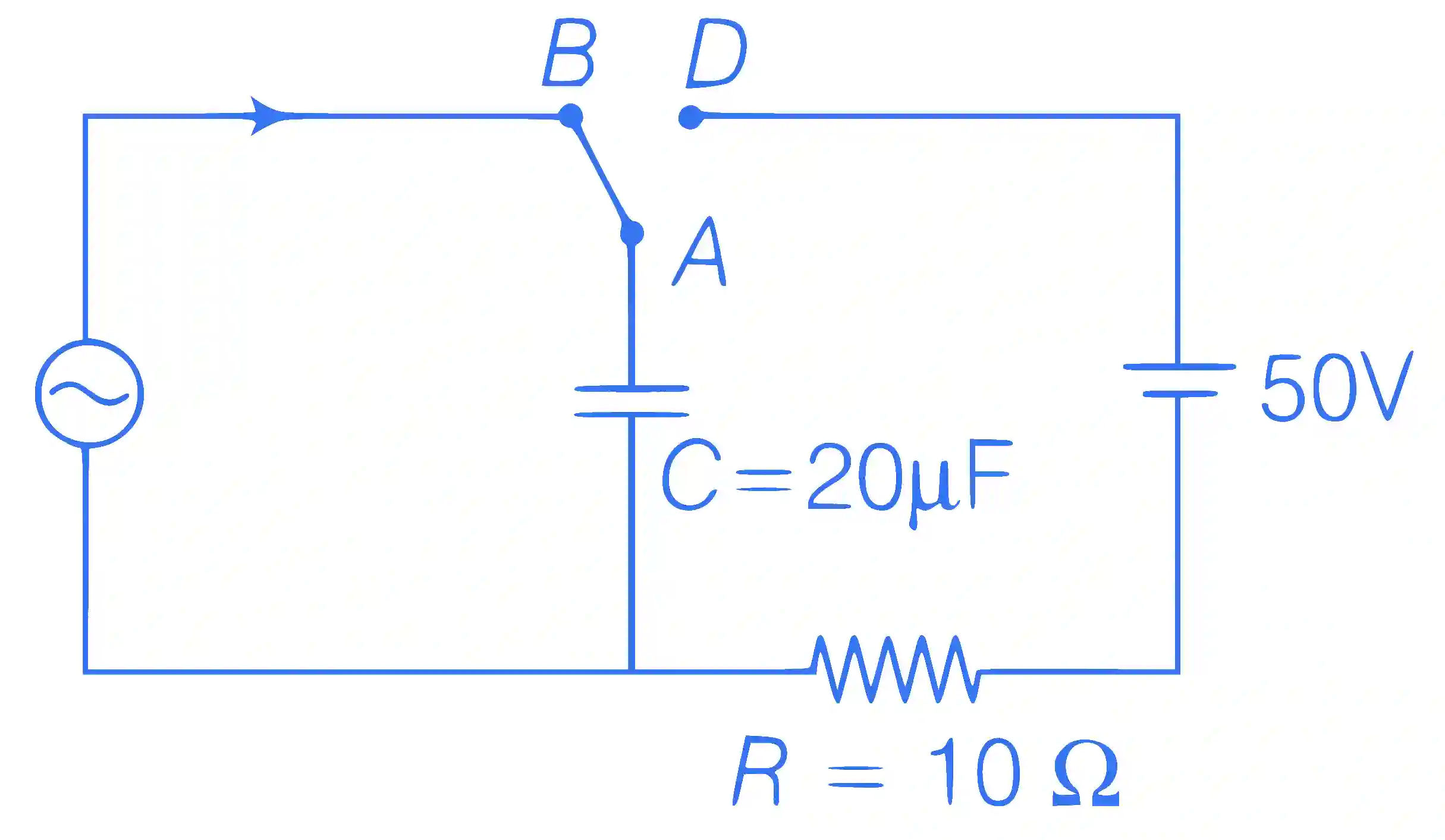
Multiple Choice Options
- A Magnitude of the maximum charge on the capacitor before is 1 10 3 C
- B The current in the left part of the circuit just before is clockwise
- C Immediately after A is connected to D, the current in R is 10 A
- D Q = 2 10 3 C
Step-by-Step Verified Solution
The current flowing through the capacitor and its charge are given by
, .... (1)
, ...... (2)
where we have used the initial condition, Q = 0 at t = 0, to get the integration constant k = 0. The charge attains the maximum value Qmax at t = / (2 ),
Qmax = i0/ = 1/500 = 2 10 3 C.
The key is switched from B to D at the time t = 7 /6 . Substitute t = 7 /6 in equations (1) and (2) to get current and charge
i = i0 cos(7 /6) = cos( + /6) = cos( /6)
A,
Qi = (i0/ ) sin(7 /6) = 2 10 3 sin( + /6)
= 1 10 3 C.
Note that negative sign in i indicates the counterclockwise direction of current and negative sign in Qi indicates the negative charge on the upper plate.
The potential across the capacitor is = 50 V (upper plate at lower potential). Immediately after A is connected to D, the potential across the resistor is VR = 100 V and hence the current through it is i = VR/R = 100/10 = 10 A (counterclockwise). The potential across the capacitor when it is fully charged is equal to the battery emf. Thus, the charge on the capacitor in fully charged condition is
Qf = V/C = 50/(20 10 6) = 1 10 3 C.
The sign of Qf indicates the positive charge on the upper plate. Hence, charge that flows through the battery is
Q = Qf Qi = 1 10 3 ( 1 10 3) = 2 10 3 C.