Verified Solution • 2025–26 Session moderate

QJEEAdv13Ma787e: JEE Advanced 2013 Mathematics - Class 12 JEEAdv13Ma787e Solution: Let (the set of all real numbers) be a function. Suppose the…

Let f:[0,1]→Rf:\left[ {0,1} \right] \to R (the set of all real numbers) be a function. Suppose the function ff is twice differentiable,
f(0)=f(1)=0f(0) = f(1)=0 and satisfies f′′(x)−2f′(x)+f(x)≥.ex,x∈[0,1]f''\left( x \right) - 2f'\left( x \right) + f\left( x \right) \ge .{e^x},x \in \left[ {0,1} \right] .

Which of the following is true for 0 < x < 1?

Multiple Choice Options

  • A 0<f(x)<∞0 < f\left( x \right) < \infty
  • B −12<f(x)<12- {1 \over 2} < f\left( x \right) < {1 \over 2}
  • C −14<f(x)<1- {1 \over 4} < f\left( x \right) < 1
  • D −∞<f(x)<0- \infty < f\left( x \right) < 0

Step-by-Step Verified Solution

Given, f(0)=f(1)=0f(0)=f(1)=0

amp; And f′′(x)−2f′(x)+f(x)≥ex,x∈[0,1]amp;⇒e−xf′′(x)−e−xf′(x)−e−xf′(x)+e−xf(x)≥1amp;⇒(e−xf′(x))′−(e−xf′(x))−(e−xf(x))′≥1amp;⇒(e−xf′(x)−e−xf(x))′≥1amp;⇒(e−xf(x))′′≥1\begin{aligned}&amp; \text { And } f^{\prime \prime}(x)-2 f^{\prime}(x)+f(x) \geq e^x, x \in[0,1] \\&amp; \Rightarrow e^{-x} f^{\prime \prime}(x)-e^{-x} f^{\prime}(x)-e^{-x} f^{\prime}(x)+e^{-x} f(x) \geq 1 \\&amp; \Rightarrow\left(e^{-x} f^{\prime}(x)\right)^{\prime}-\left(e^{-x} f^{\prime}(x)\right)-\left(e^{-x} f(x)\right)^{\prime} \geq 1 \\&amp; \Rightarrow\left(e^{-x} f^{\prime}(x)-e^{-x} f(x)\right)^{\prime} \geq 1 \\&amp; \Rightarrow\left(e^{-x} f(x)\right)^{\prime \prime} \geq 1\end{aligned}

Let g(x)=e−xf(x)g(x)=e^{-x} f(x)

Now, g(0)=e−0f(0)=0g(0)=e^{-0} f(0)=0 and g(1)=e−1f(1)=0g(1)=e^{-1} f(1)=0

Here, g^{\prime \prime}(x)=\left(e^{-x} f(x)\right)^{\prime \prime} \geq 1&gt;0

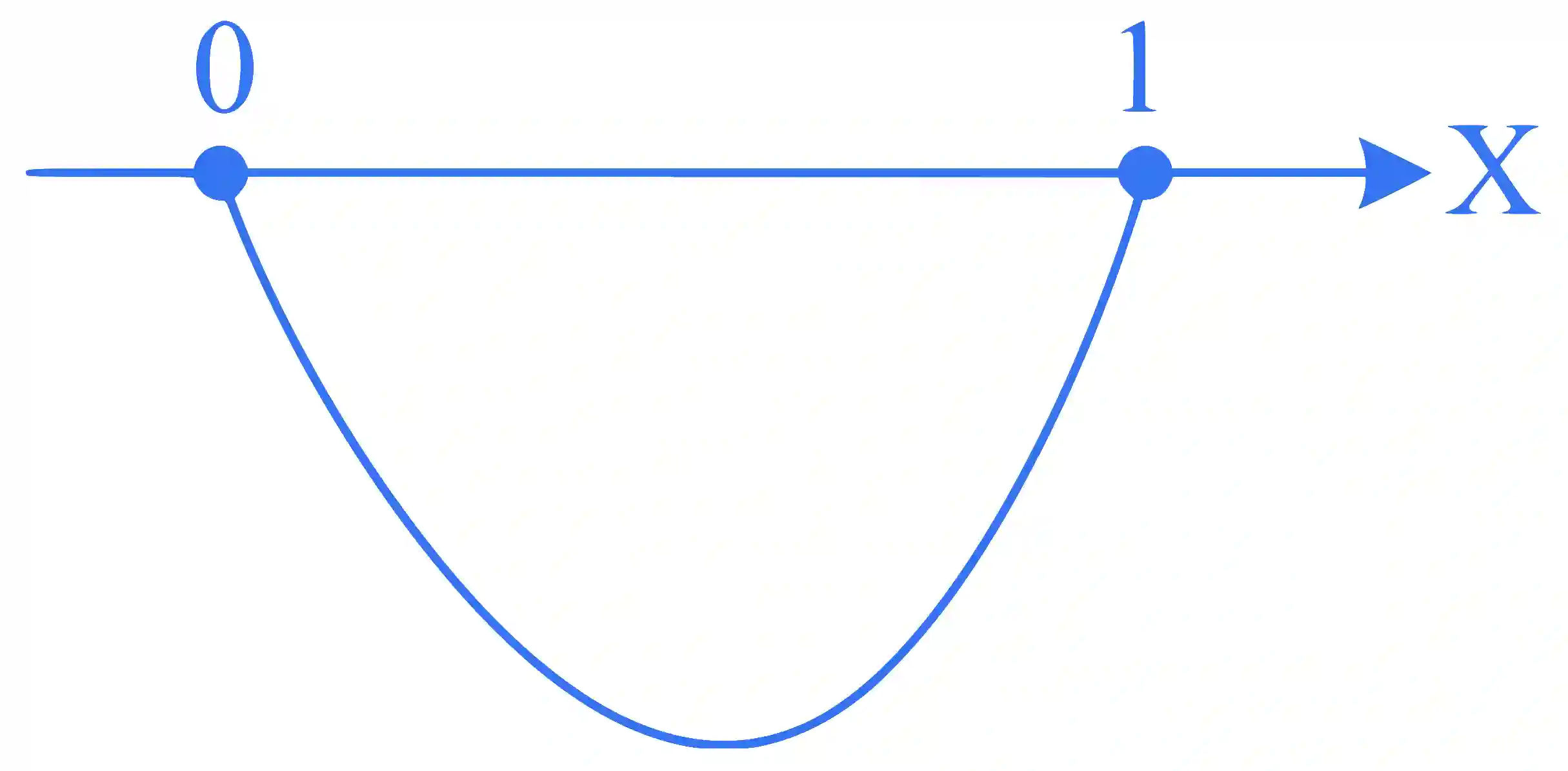
∴\therefore Concavity of g(x)g(x) is up and g(0)=g(1)=0g(0)=g(1)=0

JEE Advanced 2013 Paper 2 Offline Mathematics - Application of Derivatives Question 22 English Explanation

amp;⇒g(x)=e−xf(x)lt;0∀x∈(0,1)amp;⇒f(x)lt;0\begin{aligned}&amp; \Rightarrow g(x)=e^{-x} f(x)&lt;0 \forall x \in(0,1) \\&amp; \Rightarrow f(x)&lt;0\end{aligned}

Hints:

(i) f^{\prime \prime}(x)&gt;0 implies the concavity of f(x)f(x) is upward and f^{\prime \prime}(x)&lt;0 implies the concavity of f(x)f(x) is downward.

(ii) f^{\prime \prime}(x)&gt;0 \quad \forall x \in(a, b) and f(a)=f(b)=0f(a)=f(b)=0 implies that the concavity of the function is upward and f(x)f(x) lies below the xx -axis in the interval x∈(a,b)x \in(a, b)

Related Learning Resources & Exam Preparation