Verified Solution • 2025–26 Session moderate

QJEEAdv13Ma368e: JEE Advanced 2013 Mathematics - Class 11 JEEAdv13Ma368e Solution: A vertical line passing through the point intersects the…

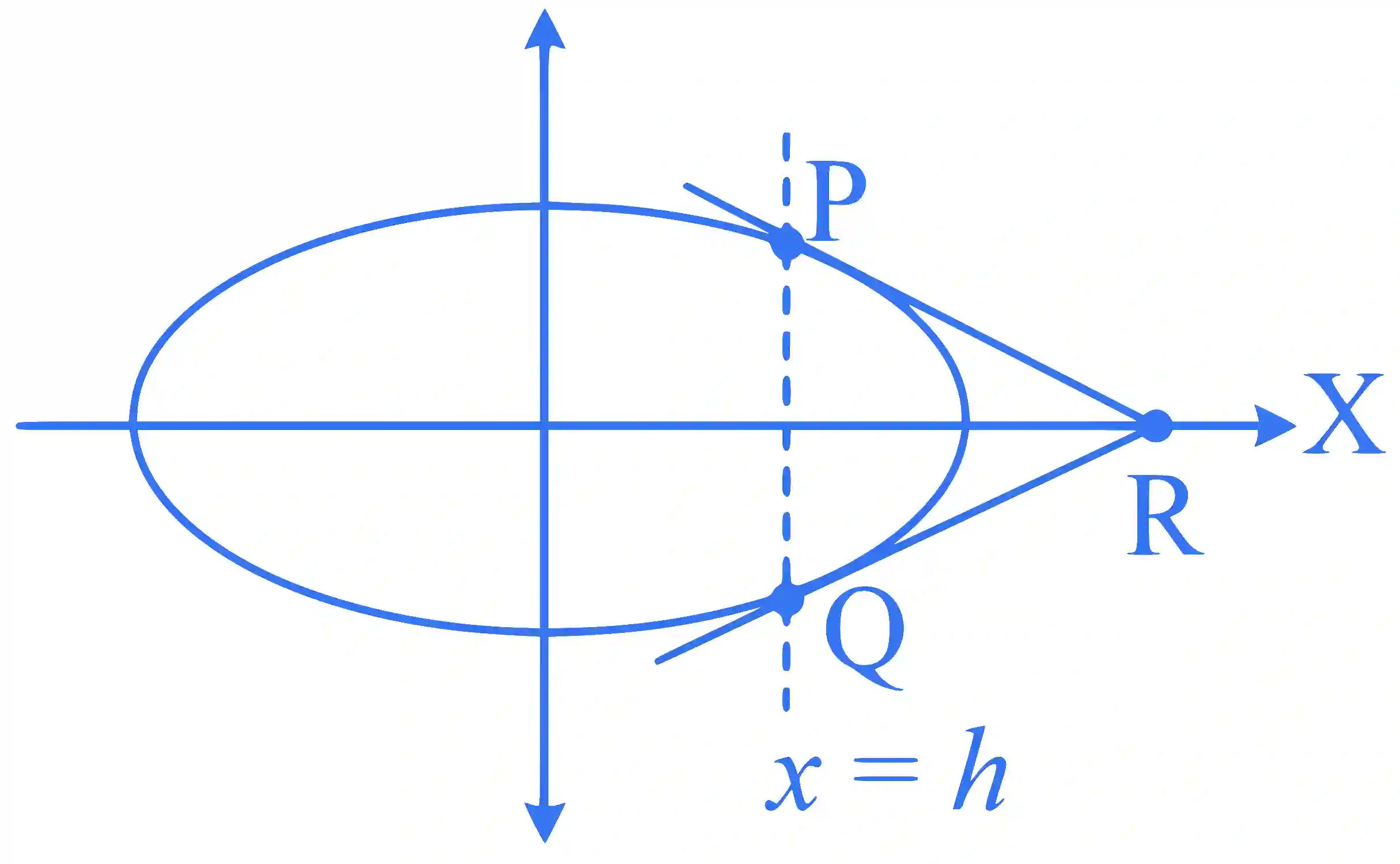
A vertical line passing through the point (h,0)(h,0) intersects the ellipse x24+y23=1{{{x^2}} \over 4} + {{{y^2}} \over 3} = 1 at the points PP and QQ . Let the tangents to the ellipse at PP and QQ meet at the point RR . If Δ(h)\Delta \left( h \right) == area of the triangle PQRPQR , Δ1{{\Delta _1}} =max⁡1/2≤h≤1Δ(h)= \mathop {\max }\limits_{1/2 \le h \le 1} \Delta \left( h \right) and Δ2{{\Delta _2}} =min⁡1/2≤h≤1Δ(h)= \mathop {\min }\limits_{1/2 \le h \le 1} \Delta \left( h \right) , then 85Δ1−8Δ2={8 \over {\sqrt 5 }}{\Delta _1} - 8{\Delta _2} =

Step-by-Step Verified Solution

JEE Advanced 2013 Paper 1 Offline Mathematics - Ellipse Question 10 English Explanation

A vertical line passing through (h,0)(h, 0) is x=hx=h and this vertical line intersect the ellipse x24+y23=1\frac{x^2}{4}+\frac{y^2}{3}=1 at P and Q.

Put x=hx=h in the ellipse x24+y23=1\frac{x^2}{4}+\frac{y^2}{3}=1

amp;⇒h24+y23=1amp;⇒y=±3−3h24\begin{aligned}& \Rightarrow \frac{h^2}{4}+\frac{y^2}{3}=1 \\& \Rightarrow y= \pm \sqrt{3-\frac{3 h^2}{4}}\end{aligned}

So P=(h,3−3h24)\mathrm{P}=\left(h, \sqrt{3-\frac{3 h^2}{4}}\right) and Q=(h,−3−3h24)\mathrm{Q}=\left(h,-\sqrt{3-\frac{3 h^2}{4}}\right)

Equation of tangent of ellipse x24+y23=1\frac{x^2}{4}+\frac{y^2}{3}=1 at P is

hx4+y33−3h24=1... (i)\frac{h x}{4}+\frac{y}{3} \sqrt{3-\frac{3 h^2}{4}}=1 \quad \text{... (i)}

Equation of tangent of ellipse x24+y23=1\frac{x^2}{4}+\frac{y^2}{3}=1 at Q is

hx4−y33−3h24=1... (ii)\frac{h x}{4}-\frac{y}{3} \sqrt{3-\frac{3 h^2}{4}}=1 \quad \text{... (ii)}

Given, RR is the point of intersection of tangents at PP and at QQ .

On solving the equations (i) and (ii)

⇒R=(8h,0)\Rightarrow \quad \mathrm{R}=\left(\frac{8}{h}, 0\right)

Given, Δ(h)=\Delta(h)= Area of ΔPQR\Delta \mathrm{PQR}

⇒Δ(h)amp;=12(8h−h)⋅23−3h24⇒Δ(h)amp;=32(8h−h)4−h2⇒dΔ(h)dh=amp;32(−8h2−1)4−h2+32(8h−h)⋅(−2h)24−h2\begin{aligned}\Rightarrow \quad \Delta(h) & =\frac{1}{2}\left(\frac{8}{h}-h\right) \cdot 2 \sqrt{3-\frac{3 h^2}{4}} \\\Rightarrow \quad \Delta(h) & =\frac{\sqrt{3}}{2}\left(\frac{8}{h}-h\right) \sqrt{4-h^2} \\\Rightarrow \quad \frac{d \Delta(h)}{d h}= & \frac{\sqrt{3}}{2}\left(\frac{-8}{h^2}-1\right) \sqrt{4-h^2} +\frac{\sqrt{3}}{2}\left(\frac{8}{h}-h\right) \cdot \frac{(-2 h)}{2 \sqrt{4-h^2}}\end{aligned}

⇒dΔ(h)dh=amp;−324−h2amp;[(8h2+1)(4−h2)+(8h−h)h]\begin{aligned}\Rightarrow \quad \frac{d \Delta(h)}{d h}= & \frac{-\sqrt{3}}{2 \sqrt{4-h^2}} \\& {\left[\left(\frac{8}{h^2}+1\right)\left(4-h^2\right)+\left(\frac{8}{h}-h\right) h\right] }\end{aligned}

amp;⇒dΔ(h)dh=−324−h2[32h2−8+4−ℏ2+8−h2]amp;⇒dΔ(h)dh=−324−h2[−2h2+32h2+4]amp;⇒dΔ(h)dh=3h24−h2[h4−2h2−16]amp;⇒dΔ(h)dh=3h24−h2[(h2−1)2−17]\begin{aligned}& \Rightarrow \quad \frac{d \Delta(h)}{d h}=\frac{-\sqrt{3}}{2 \sqrt{4-h^2}}\left[\frac{32}{h^2}-8+4-\hbar^2+8-h^2\right] \\& \Rightarrow \quad \frac{d \Delta(h)}{d h}=\frac{-\sqrt{3}}{2 \sqrt{4-h^2}}\left[-2 h^2+\frac{32}{h^2}+4\right] \\& \Rightarrow \quad \frac{d \Delta(h)}{d h}=\frac{\sqrt{3}}{h^2 \sqrt{4-h^2}}\left[h^4-2 h^2-16\right] \\& \Rightarrow \quad \frac{d \Delta(h)}{d h}=\frac{\sqrt{3}}{h^2 \sqrt{4-h^2}}\left[\left(h^2-1\right)^2-17\right]\end{aligned}

For, \frac{1}{2} \leq h \leq 1, \quad \frac{d \Delta(h)}{d h}<0

∴Δ(h)\therefore \quad \Delta(h) is a decreasing function for x∈[12,1]x \in\left[\frac{1}{2}, 1\right]

⇒Δ(1)≤Δ(h)≤Δ(12)\Rightarrow \Delta(1) \leq \Delta(h) \leq \Delta\left(\frac{1}{2}\right)

Given Δ1=max⁡12≤h≤1Δ(h)\quad \Delta_1=\max _{\frac{1}{2} \leq h \leq 1} \Delta(h) and

Δ2amp;=min⁡12≤h≤1Δ(h)⇒Δ1amp;=Δ(12) and Δ2=Δ(1)⇒Δ1amp;=32(16−12)4−14 and Δ2amp;=32(8−1)4−1⇒Δ1amp;=32×312×5⋅32 and Δ2=212⇒8Δ15amp;=93 and 8Δ2=84\begin{aligned}\Delta_2 & =\min _{\frac{1}{2} \leq h \leq 1} \Delta(h) \\\Rightarrow \quad \Delta_1 & =\Delta\left(\frac{1}{2}\right) \text { and } \Delta_2=\Delta(1) \\\Rightarrow \quad \Delta_1 & =\frac{\sqrt{3}}{2}\left(16-\frac{1}{2}\right) \sqrt{4-\frac{1}{4}} \text { and } \\\Delta_2 & =\frac{\sqrt{3}}{2}(8-1) \sqrt{4-1} \\\Rightarrow \quad \Delta_1 & =\frac{\sqrt{3}}{2} \times \frac{31}{2} \times \frac{\sqrt{5} \cdot \sqrt{3}}{2} \text { and } \Delta_2=\frac{21}{2} \\\Rightarrow \quad \frac{8 \Delta_1}{\sqrt{5}} & =93 \text { and } 8 \Delta_2=84\end{aligned}

⇒8Δ15−8Δ2=9\Rightarrow \frac{8 \Delta_1}{\sqrt{5}}-8 \Delta_2=9

Hints:

(i) If f(x)f(x) is a decreasing function in x∈[a,b]x \in[a, b] , then f(b)≤f(x)≤f(a)f(b) \leq f(x) \leq f(a)

(ii) If (x1,y1)\left(x_1, y_1\right) is a point on the curve x2a2+y2b2=1\frac{x^2}{a^2}+\frac{y^2}{b^2}=1 , then equation of tangent at (x1,y1)\left(x_1, y_1\right) is xx1a2+yy1b2=1\frac{x x_1}{a^2}+\frac{y y_1}{b^2}=1 .

Related Learning Resources & Exam Preparation