Verified Solution • 2025–26 Session moderate

QJEEAdv12Mab0e0: JEE Advanced 2012 Mathematics - Class 12 JEEAdv12Mab0e0 Solution: Let for all and let for all . Which of the following is true?

Let f(x)=(1−x)2  sin⁡2  x+x2f\left( x \right) = {\left( {1 - x} \right)^2}\,\,{\sin ^2}\,\,x + {x^2} for all x∈IRx \in IR and let
g(x)=∫1x(2(t−1)t+1−In t)f(t)dtg\left( x \right) = \int\limits_1^x {\left( {{{2\left( {t - 1} \right)} \over {t + 1}} - In\,t} \right)f\left( t \right)dt} for all x∈(1, ∞)x \in \left( {1,\,\infty } \right) .

Which of the following is true?

Multiple Choice Options

  • A gg is increasing on (1,∞)\left( {1,\infty } \right)
  • B gg is decreasing on (1,∞)\left( {1,\infty } \right)
  • C gg is increasing on (1,2)(1, 2) and decreasing on (2,∞)\left( {2,\infty } \right)
  • D gg is decreasing on (1,2)(1, 2) and increasing on (2,∞)\left( {2,\infty } \right)

Step-by-Step Verified Solution

Given,

g(x)amp;=∫1x(2(t−1)t+1−ln⁡t)f(t)dt and f(x)amp;=(1−x)2sin⁡2x+x2⇒g(x)amp;=∫1x(2(t−1)t+1−ln⁡t)((1−t)2sin⁡2t+t2)dt\begin{aligned}g(x) & =\int_1^x\left(\frac{2(t-1)}{t+1}-\ln t\right) f(t) d t \\\text { and } f(x) & =(1-x)^2 \sin ^2 x+x^2 \\\Rightarrow g(x) & =\int_1^x\left(\frac{2(t-1)}{t+1}-\ln t\right)\left((1-t)^2 \sin ^2 t+t^2\right) d t\end{aligned}

On differentiating the above equation w.r.t. xx

amp;⇒g′(x)=(2(x−1)x+1−ln⁡x)((1−x)2sin⁡2x+x2)amp;⇒g′(x)=(2−4x+1−ln⁡x)((1−x)2sin⁡2x+x2)\begin{aligned}& \Rightarrow g^{\prime}(x)=\left(\frac{2(x-1)}{x+1}-\ln x\right)\left((1-x)^2 \sin ^2 x+x^2\right) \\& \Rightarrow g^{\prime}(x)=\left(2-\frac{4}{x+1}-\ln x\right)\left((1-x)^2 \sin ^2 x+x^2\right)\end{aligned}

Here (1-x)^2 \sin ^2 x+x^2>0 for all x∈Rx \in \mathrm{R}

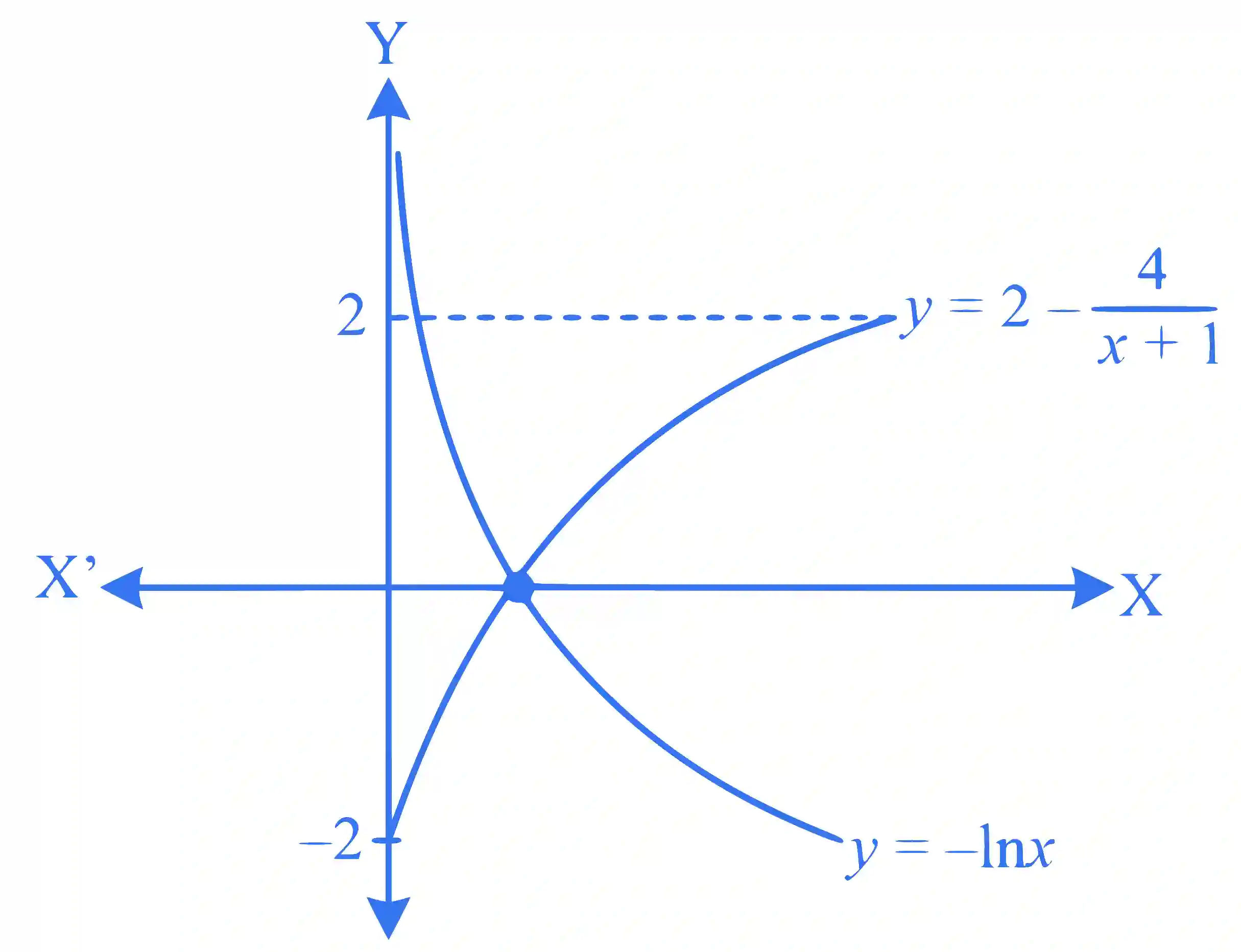
Now, draw the graph of y=2−4x+1y=2-\frac{4}{x+1} and y=−ln⁡xy=-\ln x

For x>0

IIT-JEE 2012 Paper 2 Offline Mathematics - Application of Derivatives Question 23 English Explanation 1

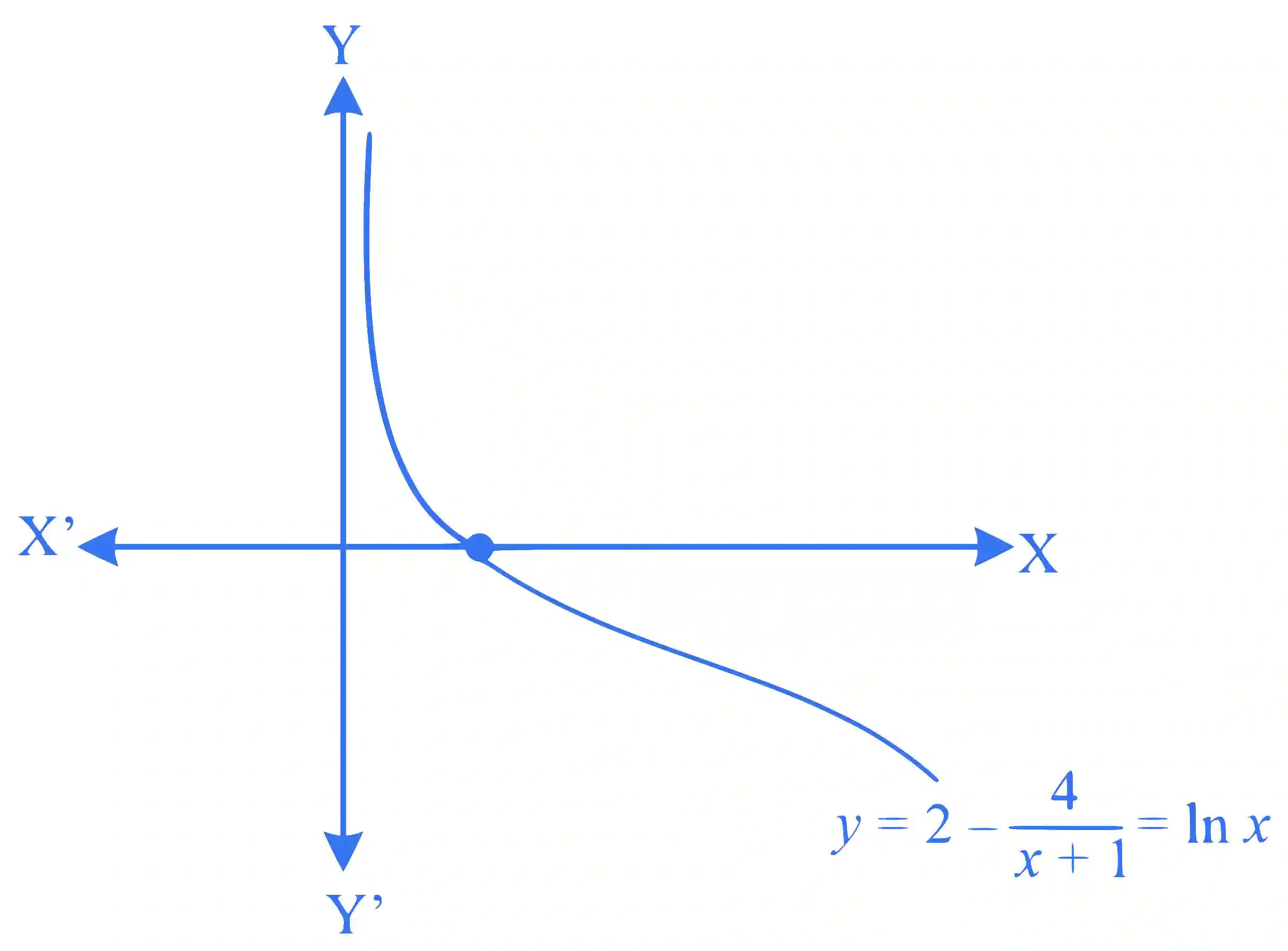
 Add the graph of y=−ln⁡x and y=2−4x+1\text { Add the graph of } y=-\ln x \text { and } y=2-\frac{4}{x+1}

IIT-JEE 2012 Paper 2 Offline Mathematics - Application of Derivatives Question 23 English Explanation 2

\Rightarrow g^{\prime}(x)<0 \text { for } x \in(1, \infty)

Hence, g(x)g(x) is decreasing function for x∈(1,∞)x \in(1, \infty)

Related Learning Resources & Exam Preparation