Verified Solution • 2025–26 Session moderate

QJEEAdv12Ma2193: JEE Advanced 2012 Mathematics - Class 12 JEEAdv12Ma2193 Solution: If for all then

If f(x)=∫0xet2(t−2)(t−3)dtf\left( x \right) = \int_0^x {{e^{{t^2}}}} \left( {t - 2} \right)\left( {t - 3} \right)dt for all x∈(0,∞),x \in \left( {0,\infty } \right), then

Multiple Choice Options

  • A ff has a local maximum at x=2x=2
  • B ff is decreasing on (2,3)(2, 3)
  • C there exists some c∈(0,∞),c \in \left( {0,\infty } \right), such that f′(c)=0f'(c)=0
  • D ff has a local minimum at x=3x=3

Step-by-Step Verified Solution

amp; Given, f(x)=∫0xet2(t−2)(t−3)dt,x∈(0,∞)amp;⇒f′(x)=ex2(x−2)(x−3)\begin{aligned}& \text { Given, } f(x)=\int_0^x e^{t^2}(t-2)(t-3) d t, x \in(0, \infty) \\& \Rightarrow \quad f^{\prime}(x)=e^{x^2}(x-2)(x-3)\end{aligned}

IIT-JEE 2012 Paper 2 Offline Mathematics - Application of Derivatives Question 73 English Explanation

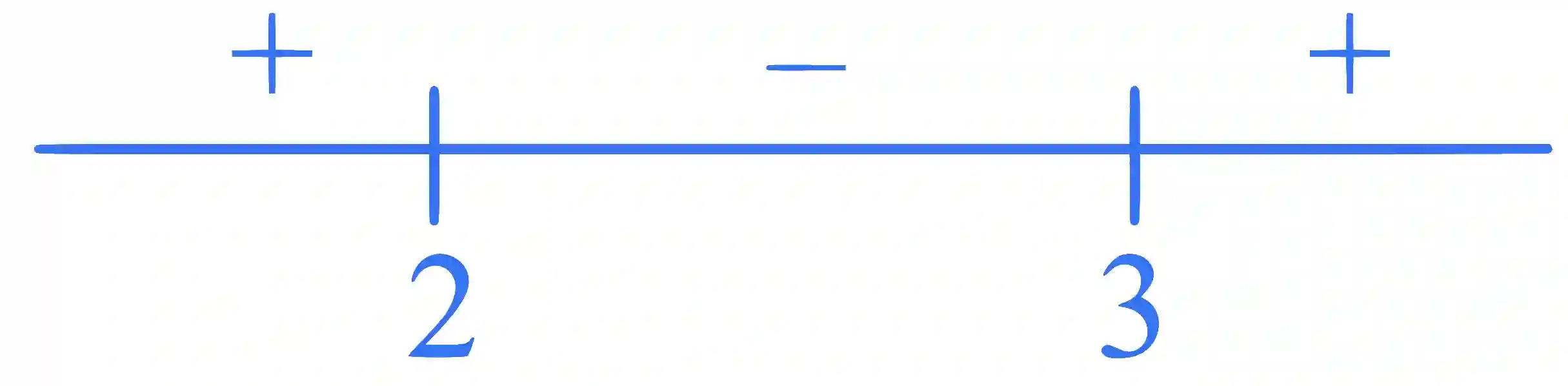
Here, f′(x)f^{\prime}(x) changes its sign +ve+v e to −ve-v e about x=2x=2 and f′(x)f^{\prime}(x) changes its sign −ve-v \mathrm{e} to +ve+v \mathrm{e} about x=3x=3

Hence, x=2x=2 is the point of local maxima and x=3x=3 is the point of local minima

\because f^{\prime}(x)<0 for x∈(2,3)x \in(2,3)

∴f(x)\therefore f(x) is decreasing on x∈(2,3)x \in(2,3)

∵f′(x)\because \quad f^{\prime}(x) is continuous and differentiable for all x(0,∞)x(0, \infty) and f′(2)=f′(3)=0f^{\prime}(2)=f^{\prime}(3)=0

∴\therefore According to Rolle's theorem, f′′(c)=0f^{\prime \prime}(c)=0 must have at least one root ∈(2,3)\in(2,3)

Related Learning Resources & Exam Preparation