Verified Solution • 2025–26 Session moderate

QJEEAdv07Phfe6c: JEE Advanced 2007 Physics - Class 11 JEEAdv07Phfe6c Solution: A small object of uniform density rolls up a curved surface…

A small object of uniform density rolls up a curved surface with an initial velocity vv . It reaches up to a maximum height of 3v24g\frac{3 v^{2}}{4 g} with respect to the initial position. The object is
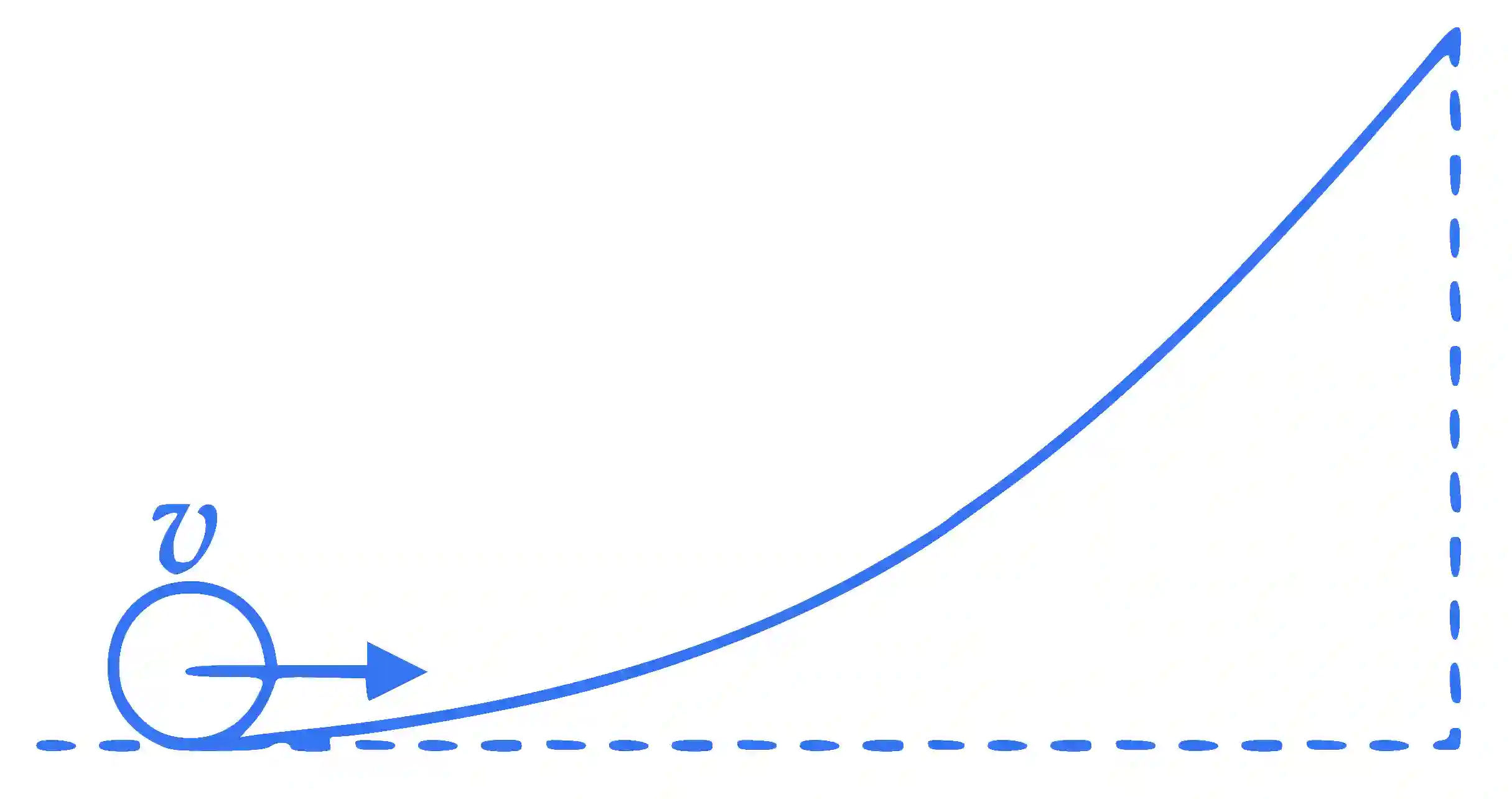
IIT-JEE 2007 Paper 2 Offline Physics - Rotational Motion Question 10 English

Multiple Choice Options

  • A ring
  • B solid sphere
  • C hollow sphere
  • D disc

Step-by-Step Verified Solution

By applying conservation of Energy, we have,

12mv2+12Iω2=mghmax⁡\frac{1}{2} m v^{2}+\frac{1}{2} \mathrm{I} \omega^{2}=m g h_{\max } ..... (i)

For pure rolling,

v=Rωv=R\omega

⇒ω=v/R\Rightarrow \quad \omega=v / \mathrm{R} ..... (ii)

Putting eq. (ii) in eq. (i), we get

⇒12mv2+12I(v2R2)=mg×3v24g\Rightarrow \frac{1}{2} m v^{2}+\frac{1}{2} \mathrm{I}\left(\frac{v^{2}}{R^{2}}\right)=m g \times \frac{3 v^{2}}{4 g} (∵hmax⁡×3v24g)\left(\because h_{\max } \times \frac{3 v^{2}}{4 g}\right)

⇒I=12MR2\Rightarrow \quad \mathrm{I}=\frac{1}{2} \mathrm{MR}^{2}

Hence, this is a required formula of moment of Inertia of Disc. Therefore, the object a disc.

2nd 2^{\text {nd }} Method : For pure rolling, the velocity of point of contact is zero i.e., v=0v=0 , So, Δx\Delta x (displacement) is zero. Then work done by the frictional force should be

W=f0Δx=0W=f_{0} \Delta x=0

If work is done by dissipative force, work done should be zero. It means that work done of system is zero. So energy should be conserved. Initially, the object has both translation as well as rotational motion. If it attains ' hmax⁡h_{\max } ' kinetic energy changes into potential energy.
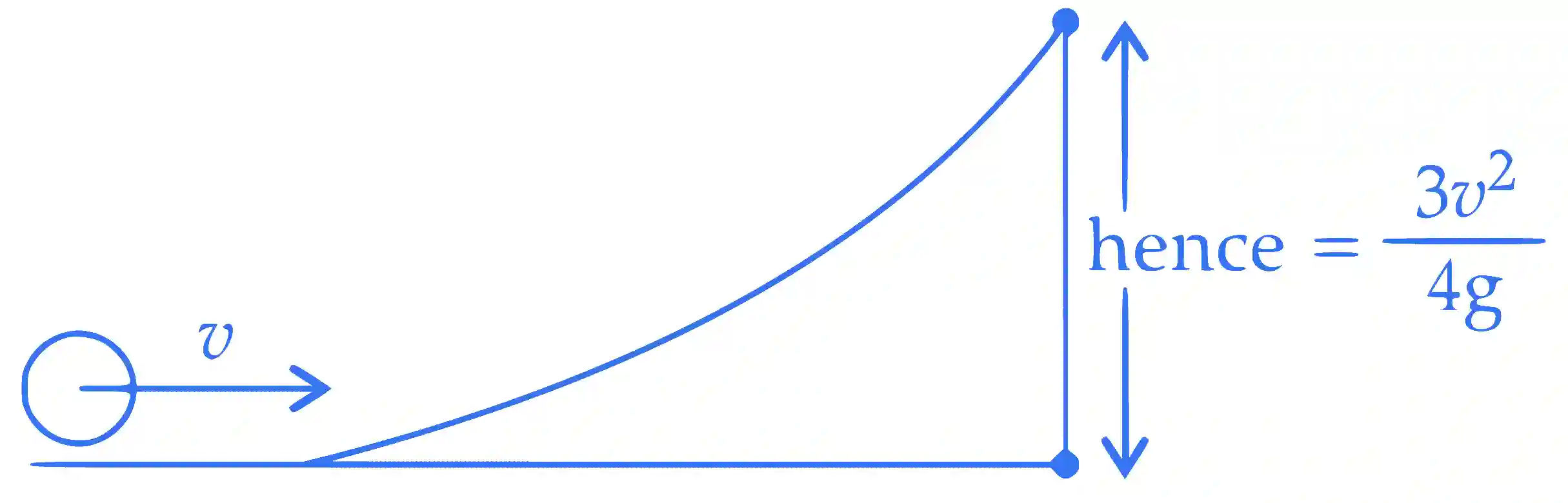
IIT-JEE 2007 Paper 2 Offline Physics - Rotational Motion Question 10 English Explanation

From energy conservation principle,

K.Etranslational +K.Erotational =\mathrm{K} . \mathrm{E}_{\text {translational }}+\mathrm{K} . \mathrm{E}_{\text {rotational }}= Potential Energy

⇒12mv2+12Iω2=mg×3v24g\Rightarrow \quad \frac{1}{2} m v^{2}+\frac{1}{2} \mathrm{I} \omega^{2}=m g \times \frac{3 v^{2}}{4 g}

⇒mv2+Iω2=3v22m\Rightarrow \quad m v^{2}+\mathrm{I} \omega_{2}=\frac{3 v^{2}}{2} m

⇒Iω2=12mv2\Rightarrow \quad \mathrm{I} \omega^{2}=\frac{1}{2} m v^{2}

⇒I=12mv2ω2\Rightarrow \quad \mathrm{I}=\frac{1}{2} \frac{m v^{2}}{\omega^{2}} ..... (i)

For No slipping,

⇒\Rightarrow amp;v=ωRamp;ω=vR\begin{aligned} & v=\omega R \\& \omega=\frac{v}{R}\end{aligned} ..... (ii)

Put eq (ii) in eq (i)

Hence, I=12MR2\quad \mathrm{I}=\frac{1}{2} \mathrm{MR}^{2}

I=12Mv2v2×R2\mathrm{I}=\frac{1}{2} \mathrm{M} \frac{v^{2}}{v^{2}} \times \mathrm{R}^{2}

this is moment of inertia of disc.

So, object is a Disc.

Related Learning Resources & Exam Preparation